When Your Podcast Hobby Becomes a Business — and Why That Line Matters More Than You Think
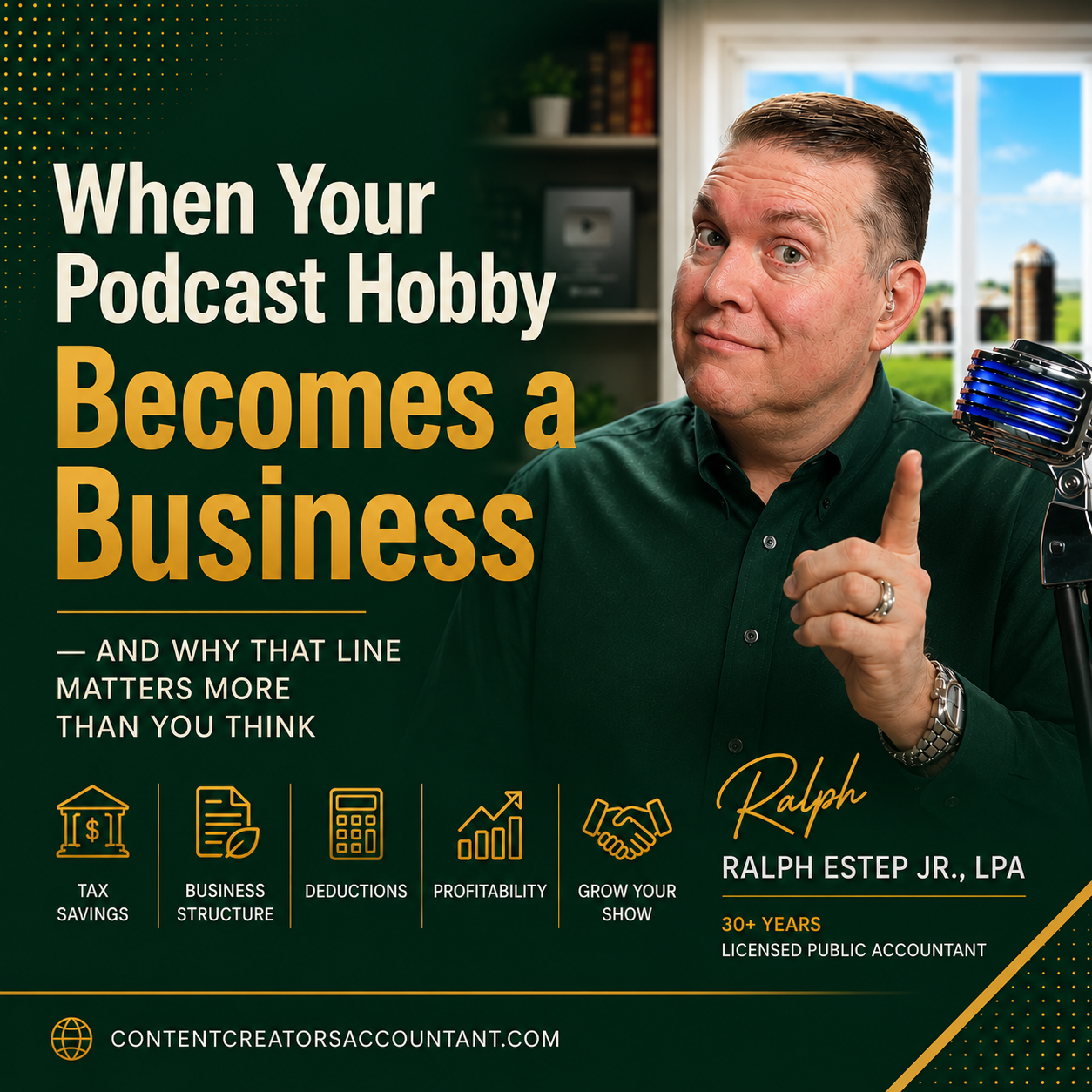
When Your Podcast Hobby Becomes a Business
And why that line matters more than you think
By Ralph Estep Jr., LPA
Let me ask you something. When you started your podcast, how did you think of it? A passion project? A creative outlet? Something you did on weekends because you loved the topic?
Most people start there. And there's nothing wrong with that. But here's the thing: the moment you started taking sponsorships, selling merchandise, getting paid for an ad read, or even accepting a free product in exchange for a mention, something shifted. In the eyes of the IRS, you may have already crossed a line.
Early sign: If you've accepted sponsorship money or affiliate income, jump to "When to Bring in a Professional" — this applies to you now.
The IRS doesn't care what you call yourself. They look at what you do.
The Hobby vs. Business Distinction — Why It Matters
Here's the simple version: if the IRS considers your podcast a hobby, you cannot deduct your expenses. That means your microphone, recording software, hosting fees, home office, and podcast conference travel. None of it.
But if your podcast is a business, those same expenses become legitimate deductions that reduce your taxable income. That's real money back in your pocket.
Hobby vs. Business at a Glance
| If It's a Hobby | If It's a Business |
|---|---|
| ❌ No deductions allowed | ✓ All eligible expenses deductible |
| ❌ Equipment costs = personal expense | ✓ Depreciate or deduct equipment |
| ❌ Home office = no deduction | ✓ Home office deduction available |
| ❌ Losses cannot offset other income | ✓ Losses deductible (within limits) |
| ❌ Income reported, but no structure | ✓ Professional accounting & legal protection |
How the IRS Actually Decides
The IRS uses a 9-factor test to determine whether an activity is a hobby or a business. No single factor automatically decides it — they look at the whole picture. But here are the ones that matter most for podcasters:
Do you operate it in a businesslike manner?
Separate bank account, contracts with sponsors, clear records, and invoices. If you combine personal and podcast money, the IRS notices.
How much time and effort do you invest?
Recording, editing, marketing, admin work, sponsorship outreach. Even 5–10 hours per week on a show signals real intent.
Do you depend on its income?
Is this your only income source, or part of your income? Does it matter to your household finances? The IRS cares about necessity.
Have you made a profit in any of the last five years?
Even one profitable year is a strong signal of business intent. Consistent losses for 5+ years raise red flags.
Are losses due to outside circumstances, or just unprofitable operations?
A bad sponsor year or illness is circumstantial. Losses from poor planning or market fit are different.
Quick rule: If your podcast has been profitable in 3 of the last 5 years, the IRS generally presumes it's a business. But don't wait — start acting like a business from Day 1.
What Actually Happens If You Get This Wrong
Let me walk you through three scenarios I've seen play out with real content creators.
Scenario 1: The IRS Reclassifies You
You've been deducting equipment and home office for two years. The IRS audits and decides this looks more like a hobby. Those deductions disappear. You owe back taxes on income you thought was offset. Plus interest and penalties. That $8,000 in deductions just cost you $15,000 in back taxes.
Scenario 2: You ARE a Business, But Don't Know It
You're making consistent sponsorship income and affiliate revenue. But you've never set up a structure or tracked expenses. You're leaving money on the table every month — equipment, software, travel, education. All deductible. All unclaimed. Across three years, that could be $15,000–$30,000 in missed deductions.
Scenario 3: You Bring Someone On Without Realizing the Implications
You hire an editor, pay a co-host, or bring on someone to manage social media. Now you have 1099 obligations, self-employment tax exposure, and possible payroll considerations. If you don't handle this right, you could face penalties from both the IRS and state labor boards.
I'm not sharing this to scare you. I'm sharing it because each situation is completely avoidable with upfront planning. The good news: you don't have to figure this out alone.
Six Steps to Make It Official the Right Way
If you've decided your podcast is a real business, here's where to start:
1. Open a separate business bank account
This is the single biggest signal of intent to the IRS. It makes recordkeeping infinitely easier. Most banks charge $5–$15/month for a business checking account.
2. Track all income and expenses
A spreadsheet works to start. QuickBooks or Wave are better once you're consistent. Sponsor payments, equipment, software, hosting, travel — capture it all.
3. Get an EIN (Employer Identification Number)
It's free, takes 10 minutes at IRS.gov, and is the foundation of your business identity. You can apply right now.
4. Decide on a business structure
Sole proprietor is fine to start. As income grows, an LLC or S-Corp may save you thousands in taxes. This is where a conversation with an accountant pays for itself.
5. Set aside money for self-employment tax
If you're self-employed, you owe 15.3% on your net profit. Save 25–30% of income for taxes. Most people find this out the hard way.
6. Talk to an accountant who understands creators
Not just any tax preparer. Someone who knows podcasters, YouTubers, and content creators specifically. They'll help you structure things right from the start.
You are building something real. Treat it that way from the beginning, and the IRS will too.
When Should You Bring in a Professional?
Here's my honest answer: earlier than you think.
You can absolutely handle the basics on your own in the early days — opening a bank account, tracking income, and keeping receipts. But once you're making consistent money from your podcast, even $500 a month, it's worth a conversation with someone who can look at your specific situation.
The cost of working with an accountant is almost always less than the cost of getting it wrong. I've helped creators dig out of situations that could have been avoided entirely with one conversation at the start.
That's exactly why I created The Content Creator's Accountant. I built it specifically for people like you — podcasters, YouTubers, and course creators who are great at creating but didn't sign up to be their own CFO.
Ready to Stop Guessing and Start Knowing?
At The Content Creator's Accountant, I work exclusively with podcasters and creators who are serious about treating their shows like the businesses they are.
Learn More at The Content Creator's AccountantVisit contentcreatorsaccountant.com
The Bottom Line
The line between hobby and business isn't something you get to choose based on how you feel about your podcast. The IRS draws it based on what you do.
The good news is that once you understand where that line is, you can position yourself on the right side of it and start keeping more of the money you're working hard to make.
If you've been winging the business side of your podcast, today is the day to change that. You've already done the hard part — you built an audience, you showed up consistently, you created something real. Now let's make sure the financial infrastructure matches the quality of what you're putting out.
— Ralph Estep Jr., LPA
The Content Creator's Accountant

President
Ralph V. Estep, Jr. is a Delaware-based licensed accountant, author, rancher, and media host with more than 30 years of experience in finance, taxation, and small-business leadership. As the founder of Saggio Accounting+PLUS and the creator of the Ask Ralph Media network, Ralph helps entrepreneurs, creators, and everyday families replace money confusion with clarity, confidence, and practical next steps—without shame and without hype.
Ralph’s work blends deep professional expertise with a coach’s mindset and a communicator’s heart. He has held leadership roles across public accounting, financial institutions, law firms, and technology organizations, bringing a rare combination of traditional accounting rigor and modern systems thinking to the people he serves. A graduate of the University of Delaware and Wilmington University (MBA), Ralph is known for turning complex money topics into simple, repeatable frameworks that help people make wiser decisions and build lasting financial stability.
Through Ask Ralph Media, Ralph hosts multiple shows designed to meet people where they are and guide them forward. He is the host of Financially Confident Christian, a daily, faith-based show offering warm, pastoral encouragement for listeners who want peace and practical wisdom with their finances.
He also hosts Truth Unveiled with Ralph, a weekly program that contrasts cultural pressure with biblical truth and invites listeners into deeper spiritual and practical alignment. For small business owners, Ralph leads Grit and Growth Business, spotlighting real sto… Read More
The Real Reason Your Podcast Isn't Making You Money