Stop Fighting About Audio vs. Video. Your Audience Doesn't Care.
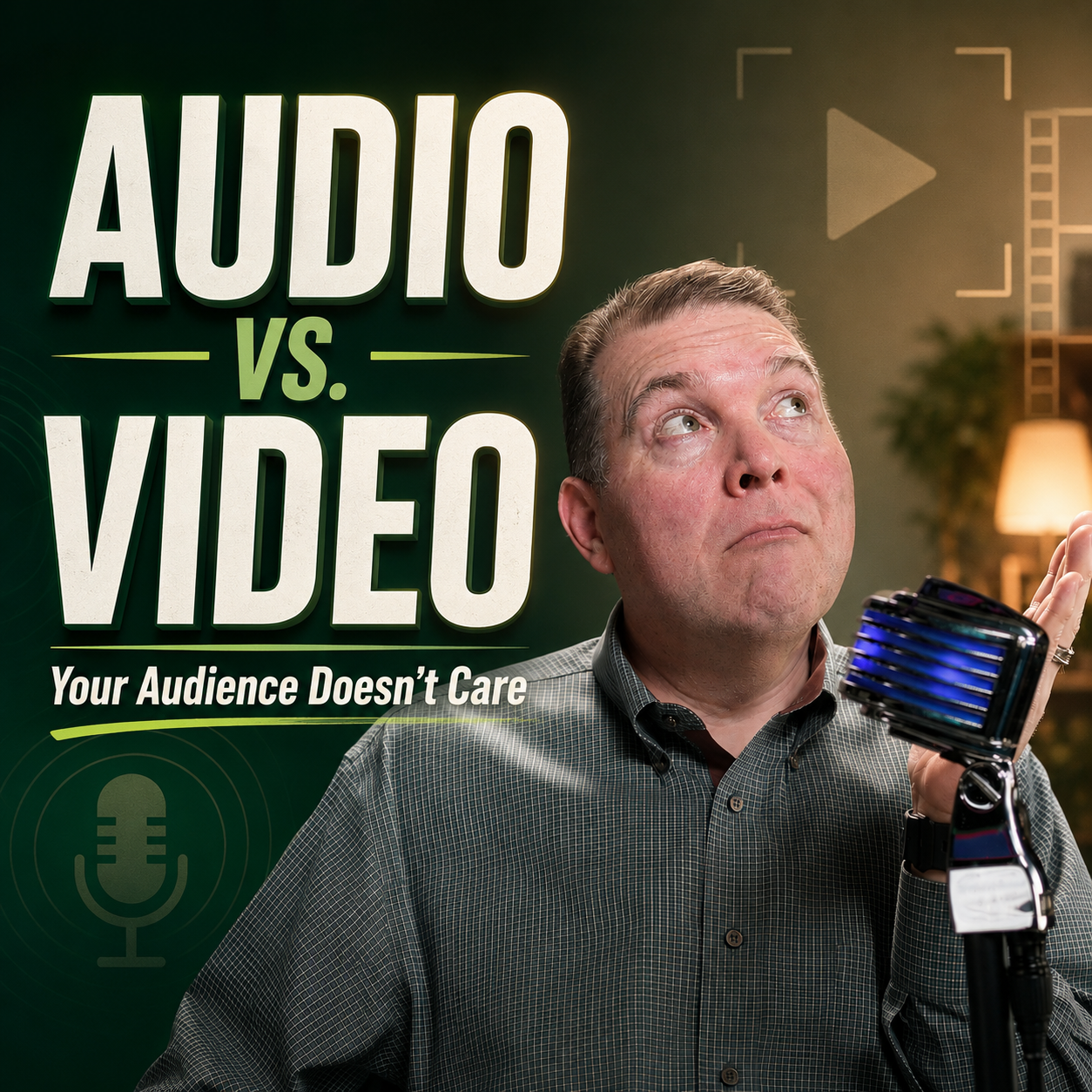
Stop Fighting About Audio vs. Video. Your Audience Doesn't Care.
Picture the creator who spends four months building the perfect video studio. Ring lights. A camera that cost more than their first car. A backdrop they agonized over for weeks. They hit publish on a gorgeous first episode and then they sit there, refreshing the numbers, and... nothing.
Meanwhile the exact person they built all of it for is out in their car, both hands on the wheel, stuck in traffic, wishing somebody would just talk to them.
That's the cost of getting this backwards. So I'll be straight with you: most of us get it backwards.
Every week I watch creators go to war over the same question. One camp says audio first: it's intimate, it's cheap, people listen while they drive and fold laundry and walk the dog. The other camp says video first: that's where discovery lives, that's where the algorithm rewards you, that's where the money is now.
Both camps are right. And both camps are arguing about the wrong question.
In this post
Audio vs. video is a delivery decision
It's step two. You've been fighting about step two while step one sits there, unanswered.
Get the first question right and the format question mostly answers itself. Get it wrong and it will not matter which one you pick. You can shoot in 4K or record on a fifty-dollar mic, if you don't know who it's for, you're just producing beautiful content for nobody.
Who are you serving, and where are they already?
Answer that first. Audio vs. video is just logistics after that.
Your audience is an asset, not a follower count
Thirty years reading the books of small businesses taught me something most creators never stop to consider: your audience is an asset. A real one.
If your content business showed up on a balance sheet, your audience, the trust you've built, the attention you've earned, the people who open the email and actually hit play, would be the single most valuable line item you own. More valuable than your gear. More valuable than your back catalog.
Nobody buys a camera for an asset that valuable before they understand the asset itself. That's like a restaurant owner obsessing over a gas range versus an induction cooktop before a single person has asked what the customers want to eat. Figure out the asset first. Then buy the equipment to serve it.
The math that changes everything
On the show, everything I teach runs through one framework, the Creator Revenue Formula:
Audience × Problem × Offer = Value
Look at what sits in the very first position. Not "format." Not "platform." Not "which mic." Audience. Now look at that little multiplication sign, because it's doing all the work.
Say your offer is a 9 out of 10, genuinely great, you've poured everything into it, but your audience clarity is a 2, because you've never really nailed down who you're serving.
| Fuzzy audience 9 × 2 = 18 | Clear audience 9 × 8 = 72 |
Same offer. Same effort on the product. You didn't work harder or build a better offer, you just stopped multiplying your best work by a small number. Audience first isn't a slogan, it's arithmetic.
What this looks like on Monday morning
This changes real decisions, not just how you think.
Start with format. Are the people you serve commuting, exercising, working with their hands? Audio meets them where they already live. Are they searching for how-to answers and comparing options with their eyes? Video wins. You don't pick the format you like. You pick the one your audience is already inside of.
Then look at your topics. Audience first means you stop making the content you want to make and start making the content that answers what's actually keeping them up at 2 a.m. It's the same skill either way, just aimed at a completely different result.
Your offer works the same way. Most creator offers don't flop because of the price or the funnel. They flop because they were built for the creator's comfort instead of the audience's outcome. Know your audience cold and the offer stops being a guess.
And what you measure has to shift too. This is where the accountant in me really starts talking. Download counts and view counts feel wonderful, but they're vanity the second they're disconnected from the people you're trying to reach. I'd take 500 of the right listeners over 50,000 strangers any day. One of those is a business. The other is a hobby that happens to have impressive numbers.
Before your next big move
So here's my arm around your shoulder before you pour the next six months into a rebrand, a new show, or a platform you're about to bet on.
Stop and answer one question, out loud: Do I actually know who this is for? Not a demographic. Not "women 25 to 40." A real human being with a real problem you can name in a single sentence.
Nail that, and audio-first versus video-first becomes what it always should have been, a simple logistics call with an obvious answer. Miss it, and you'll have the nicest studio no one's watching.
Audience first. Everything else is just how you deliver it.
Frequently asked questions
Should I start with audio or video for my content business?
Neither, start by identifying who you're serving and where they already spend their attention. Once you know that, the format usually picks itself: audio for people who are commuting, exercising, or doing tasks with their hands, video for people actively searching for how-to answers or comparing options visually.
What is the Creator Revenue Formula?
It's Audience times Problem times Offer equals Value. Because it's multiplication, a weak score in any one factor, especially audience clarity, drags the whole result down no matter how strong your offer is.
How do I find my audience before choosing a format?
Name a real person with a real problem you can describe in one sentence, not a broad demographic like "women 25 to 40." Then figure out where that specific person already spends their time and attention, and build around that.
Why do download and view counts matter less than audience clarity?
Because raw numbers are vanity metrics once they're disconnected from the specific people you're trying to reach. Five hundred listeners who are exactly who you're built for outperform fifty thousand strangers, one is a business, the other is a hobby with impressive numbers.
Is your content actually built around your audience?
I put creators through a straight, no-fluff review of where the real value is hiding in their content business, bookkeeping, taxes, and everything else that determines whether it's a real business or an expensive hobby.
Start Your Free Audit
President
Ralph V. Estep, Jr. is a Delaware-based licensed accountant, author, rancher, and media host with more than 30 years of experience in finance, taxation, and small-business leadership. As the founder of Saggio Accounting+PLUS and the creator of the Ask Ralph Media network, Ralph helps entrepreneurs, creators, and everyday families replace money confusion with clarity, confidence, and practical next steps—without shame and without hype.
Ralph’s work blends deep professional expertise with a coach’s mindset and a communicator’s heart. He has held leadership roles across public accounting, financial institutions, law firms, and technology organizations, bringing a rare combination of traditional accounting rigor and modern systems thinking to the people he serves. A graduate of the University of Delaware and Wilmington University (MBA), Ralph is known for turning complex money topics into simple, repeatable frameworks that help people make wiser decisions and build lasting financial stability.
Through Ask Ralph Media, Ralph hosts multiple shows designed to meet people where they are and guide them forward. He is the host of Financially Confident Christian, a daily, faith-based show offering warm, pastoral encouragement for listeners who want peace and practical wisdom with their finances.
He also hosts Truth Unveiled with Ralph, a weekly program that contrasts cultural pressure with biblical truth and invites listeners into deeper spiritual and practical alignment. For small business owners, Ralph leads Grit and Growth Business, spotlighting real sto… Read More
Stop Chasing Revenue Streams: Build Offers Around Real Problems