Your Podcast Is Already a Consulting Business — You Just Haven't Started Charging for It Yet
Your Podcast Is Already a Consulting Business — You Just Haven't Started Charging for It Yet
By Ralph Estep Jr.
Let me ask you something.
Has anyone ever slid into your DMs asking for advice in your niche? Have you been the go-to person in a Facebook group, answering questions that nobody else could answer? Has someone invited you to speak, guest on their show, or present at an event — and you said yes, for free?
That was consulting. That was speaking. And you did it at no charge.
I talk to content creators every week as their accountant, and this is one of the most common things I see. Talented, knowledgeable podcasters who are sitting on a monetization asset they don't fully recognize yet. Their podcast — their show, their back catalog, their voice — is already functioning as a public portfolio of their expertise. They just haven't flipped the switch from creator to professional.
Today I want to talk about what it looks like when you flip that switch.
What Your Podcast Is Actually Proving Every Week
Every time you publish an episode, you're demonstrating three things that clients and event organizers pay good money for: subject matter expertise, the ability to communicate clearly, and the power to hold an audience's attention.
That's the exact skill set people hire speakers and consultants for.
And here's what most indie podcasters don't realize — you don't need 100,000 downloads to get hired. You need to be the most credible voice in a specific niche. A focused show with 40 solid episodes in a defined space will get you further than a massive general audience when it comes to landing paid opportunities.
When an event organizer Googles potential speakers, your show is the demo reel. When a brand wants to hire a consultant in your topic area, your back catalog serves as proof of your work. The RSS feed is already selling for you. You just need to give it somewhere to send people.
What Podcasters Actually Get Hired to Do
This is where I see eyes light up in conversations, because the opportunities are broader than most people think.
Keynotes and panel speaking. Industry events, conferences, and associations are always looking for credible voices in niche areas. A small but loyal audience in the right vertical is more valuable to a conference organizer than raw download numbers.
Podcast strategy consulting. Brands, businesses, and other creators want to launch or grow their own shows. If you've been doing this for a while, you know things they don't. That knowledge has a price tag.
Niche subject consulting. Whatever your podcast is about — fitness, finance, parenting, marketing, real estate — companies in that space hire outside experts all the time. Your episodes are evidence that you know the subject.
Corporate workshops and training. HR and learning teams are constantly looking for topic experts who can actually communicate. Someone who hosts a podcast can hold a room. That's not a small thing.
What to Charge When You're Just Starting Out
This is where people freeze. So let me give you a real starting framework.
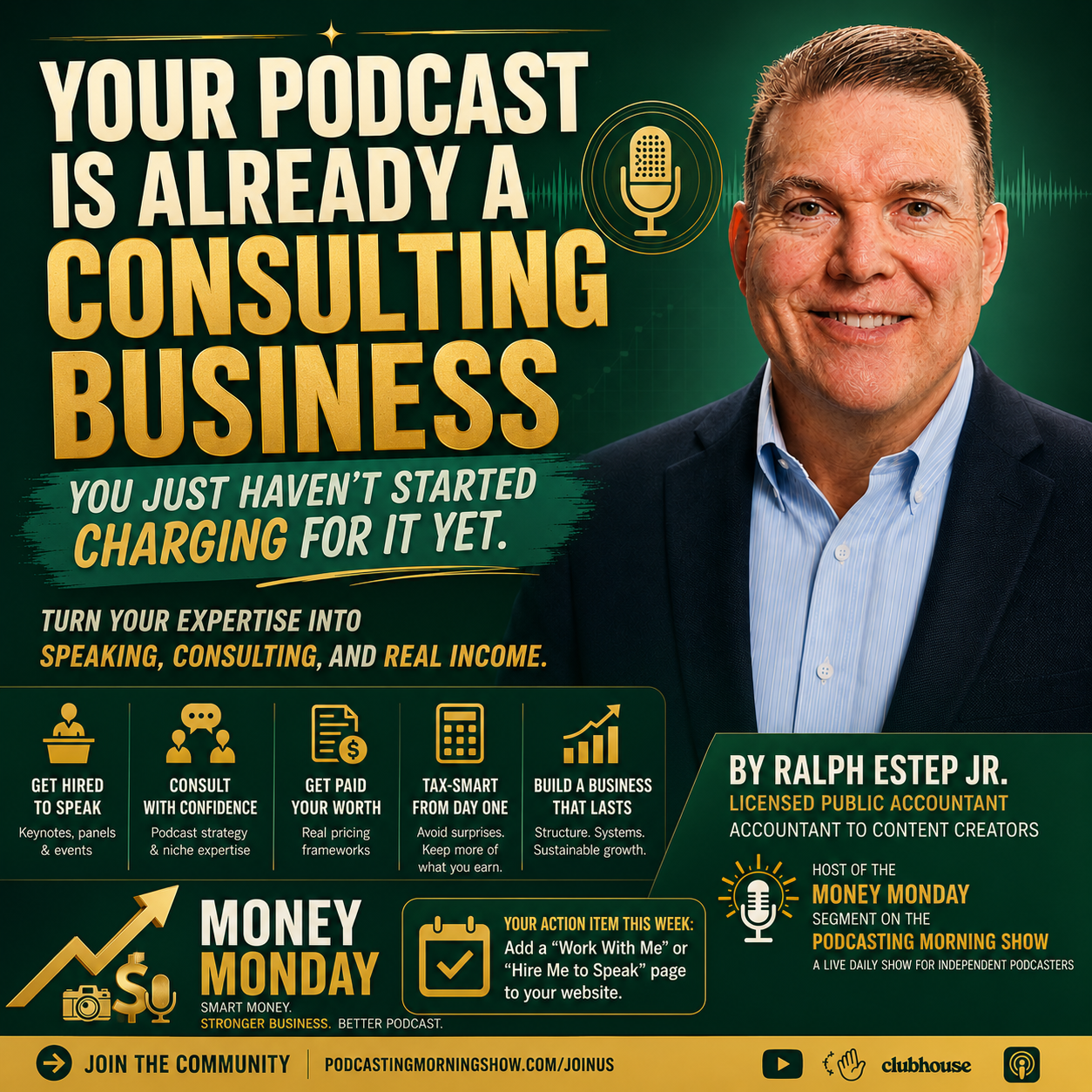
For speaking: start with free gigs if you need to build a reel, but always get the recording and a testimonial. From there, $250–$1,000 is a reasonable starting range for small community events and local conferences. Virtual keynotes and online summits can run $500–$2,500.
For consulting: $75–$200 per hour is a realistic starting range for most niches. Project-based packages of $500–$2,500 per engagement often work better than hourly — they're easier to quote, and you usually earn more.
One rule I give every client: use your current day job hourly rate as your floor. Never go below it. And once you've done three to five engagements and collected testimonials, raise your rates. Those first gigs are as much market research as they are income.
The Tax Reality Nobody Warns You About
Here's where I put my Licensed Public Accountant hat on, because this is exactly where podcasters get surprised.
The moment money changes hands for speaking or consulting — even $50 from a friend — that is self-employment income. And self-employment income comes with self-employment tax, which runs roughly 15.3% on top of your regular income tax. Budget 25–30% of every dollar for taxes from day one.
Quarterly estimated taxes are due four times a year. If you miss them, you don't just owe more in April — you pay penalties on top of it. The IRS doesn't grade on a curve for first-timers.
Use a contract every single time. A simple one-page agreement protects both parties and establishes you as a professional. It also makes it very clear what you're being paid for — which matters when expense reimbursements come into play. Travel costs reimbursed by the client are not income. But cash payments always are, no matter what you call them.
And track every expense from day one. Your travel to speaking engagements, your home office, your courses and books, your equipment, your website updates — these are deductible business expenses. 30 seconds of tracking now save 2 hours of stress in April.
Your Action Item This Week
Add a "Work With Me" or "Hire Me to Speak" page to your podcast website. It doesn't have to be perfect. Three sentences about what you do, a list of three to five topics you could speak on or consult about, and a contact email. That's it.
The moment that page is live, you are operating as a business — even before the first dollar comes in. And that's when the conversation about structure, separate bank accounts, and business planning becomes real.
Your podcast has been doing the work. It's time to start getting paid for it.
Ralph Estep Jr. is a Licensed Public Accountant and an accountant to content creators. He hosts the Money Monday segment on the Podcasting Morning Show, a live daily show for independent podcasters on YouTube and Clubhouse. Join the community at podcastingmorningshow.com/joinus.
President
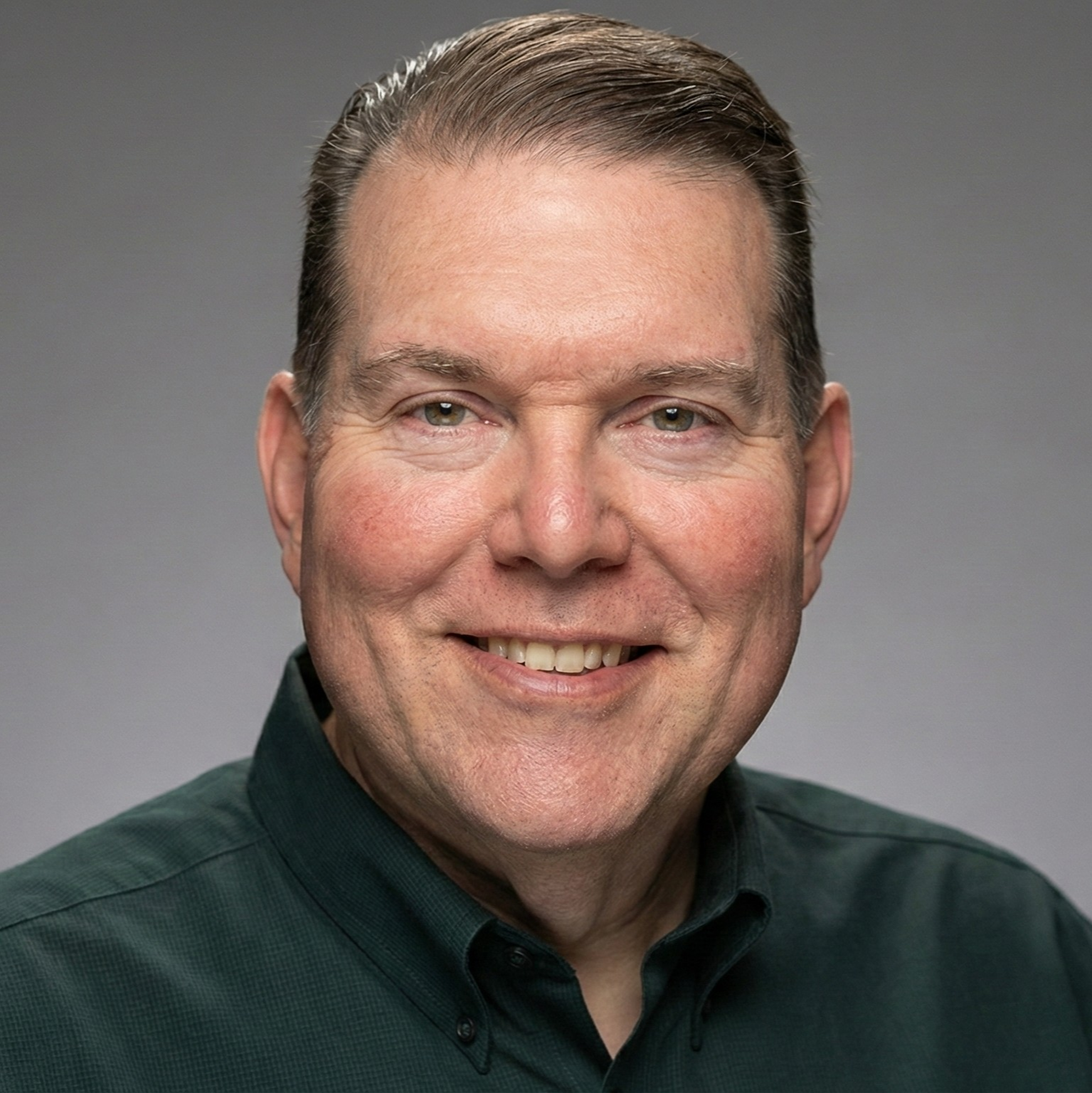
Ralph V. Estep, Jr. is a Delaware-based licensed accountant, author, rancher, and media host with more than 30 years of experience in finance, taxation, and small-business leadership. As the founder of Saggio Accounting+PLUS and the creator of the Ask Ralph Media network, Ralph helps entrepreneurs, creators, and everyday families replace money confusion with clarity, confidence, and practical next steps—without shame and without hype.
Ralph’s work blends deep professional expertise with a coach’s mindset and a communicator’s heart. He has held leadership roles across public accounting, financial institutions, law firms, and technology organizations, bringing a rare combination of traditional accounting rigor and modern systems thinking to the people he serves. A graduate of the University of Delaware and Wilmington University (MBA), Ralph is known for turning complex money topics into simple, repeatable frameworks that help people make wiser decisions and build lasting financial stability.
Through Ask Ralph Media, Ralph hosts multiple shows designed to meet people where they are and guide them forward. He is the host of Financially Confident Christian, a daily, faith-based show offering warm, pastoral encouragement for listeners who want peace and practical wisdom with their finances.
He also hosts Truth Unveiled with Ralph, a weekly program that contrasts cultural pressure with biblical truth and invites listeners into deeper spiritual and practical alignment. For small business owners, Ralph leads Grit and Growth Business, spotlighting real sto… Read More

Estimated Tax Safe Harbor: Why Paying On Time Can Still Leave You With a Big April Bill