The Real Math Behind Podcast Sponsorships (And Why It Rarely Adds Up)
The Real Math Behind Podcast Sponsorships (And Why It Rarely Adds Up)
Every new podcaster asks me the same question a few episodes in: how do I get sponsors? It's the model everyone talks about. Big shows say "this episode is brought to you by," and it sounds like the finish line, the proof you've made it. But podcast sponsorships are a byproduct of building something valuable, not the thing that builds it. And for most creators, they were never going to replace a real income in the first place.
Let's run the actual numbers, because the math tells a different story than the dream does.
What does a podcast sponsorship actually pay?
Most ad deals run on CPM, cost per thousand downloads. The typical range sits between $15 and $30 per thousand. At 1,000 downloads with one ad spot, you're looking at $15 to $30 total. Scale up to 5,000 downloads, and you're at $75 to $150. At 20,000 downloads, maybe $300 to $600 per slot, with room for a pre-roll, mid-roll, and post-roll.
That CPM number hides four things nobody mentions. Fill rate first: about half of your ad inventory typically goes unsold. Then the platform's cut, often 20 to 30 percent off the top. Add a mid-roll premium that only kicks in if advertisers actually want your niche. And don't forget taxes on that income plus the hours spent producing and reading the spots. Six hundred dollars on paper shrinks fast once those four things take their bite.
Why sponsorships rarely replace a real income
Say you're making $5,000 a month and someone tells you sponsorships can replace it. Run the math with a weekly show, two ad slots per episode, a healthy $25 CPM. You'd need roughly 25,000 downloads per episode, every week, before fill rates and platform cuts even get factored in. After those, closer to 40,000 downloads a week, or 160,000 a month.
Most podcasts never crack a thousand downloads an episode. Hit 5,000 and you're near the top of the entire medium. Chasing a full income from sponsors alone isn't a plan. It's a bet that requires you to already have a massive audience just to place it.
That's the trap. Sponsorships require scale, which means every decision starts bending toward more downloads instead of better service to your actual audience. Louder titles, trendier topics, chasing the algorithm. I've watched that treadmill lead to the same three places every time: burnout, frustration, and income that never quite shows up.
There's also the dependence problem. Your income relies on someone else's marketing budget, and marketing is the first line item cut when the economy tightens. I've watched this in business for thirty years. Build your show around sponsors and lose your top two advertisers in one quarter, and your income falls off a cliff even though your audience and your work never changed.
A tale of two podcasts
I've seen this play out with real creators. One show pulls 20,000 downloads an episode and monetizes through ads and sponsorships, landing between $2,000 and $3,000 a month. Another show, a tenth the audience at 2,000 downloads an episode, skips the ads entirely and monetizes through consulting and coaching. That second show brings in $10,000 a month and up.
Smaller audience, bigger revenue, because that creator owns the relationship instead of renting it out to advertisers by the thousand.
Five revenue streams you actually control
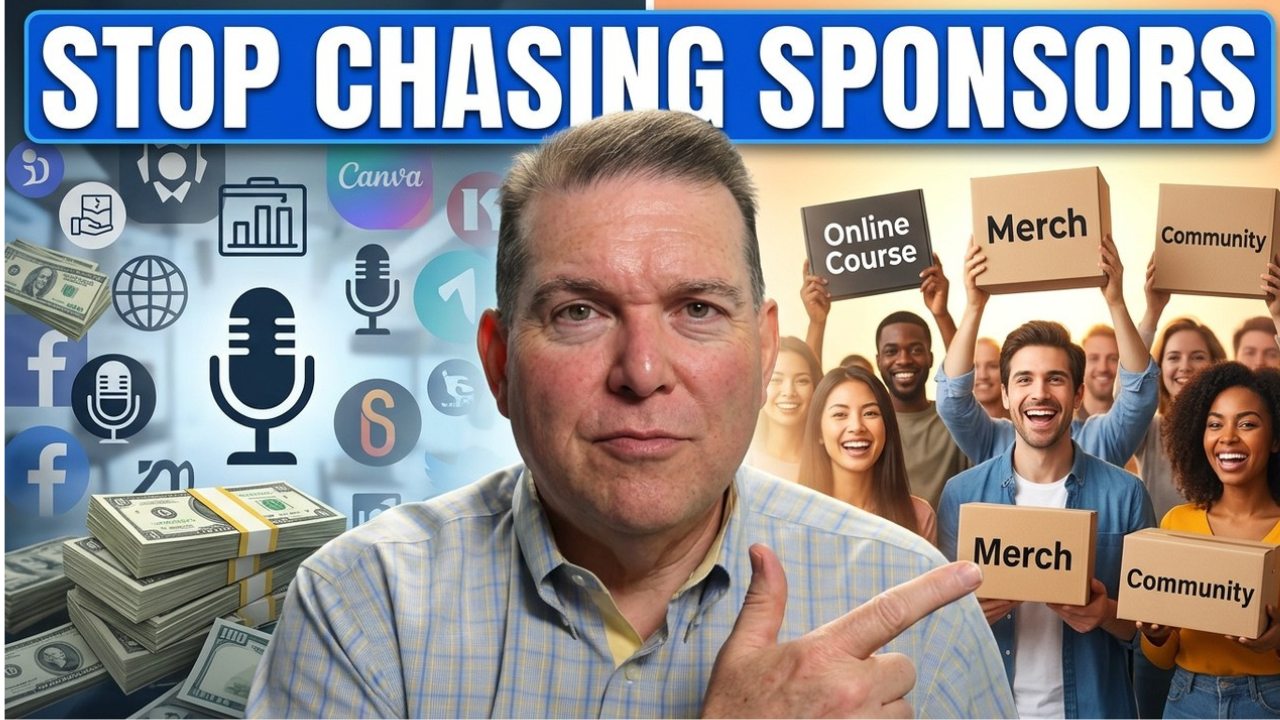
If sponsors aren't the foundation, what is? Services, where you do the work directly through consulting, is the fastest path to real money. Coaching lets you guide people to do the work themselves, one-on-one or in a group. Digital products like courses and templates get built once and sold over and over. Memberships create recurring revenue from people who want to stay close to your world. And an ecosystem combines all of it: a free show on top, a paid offer in the middle, a deeper paid relationship at the core, each layer getting stronger as trust grows rather than as the audience gets bigger.
Sponsorships still have a place once you already have serious scale, a brand that genuinely fits your content, or an affiliate relationship built on trust you'd recommend anyway. In every one of those cases, sponsorship sits on top of something you already own. It's the icing, never the cake.
Go back to the basics: audience, problem, offer. Line those three up and you don't need to chase downloads to make money. You just need to serve the right people better than anyone else. Everything past that is volume.
If you're building your business around sponsors and it's not adding up, let's talk. Head to contentcreatorsaccountant.com/audit for a content monetization audit, and I'll show you where the real opportunity is sitting.

President
Ralph V. Estep, Jr. is a Delaware-based licensed accountant, author, rancher, and media host with more than 30 years of experience in finance, taxation, and small-business leadership. As the founder of Saggio Accounting+PLUS and the creator of the Ask Ralph Media network, Ralph helps entrepreneurs, creators, and everyday families replace money confusion with clarity, confidence, and practical next steps—without shame and without hype.
Ralph’s work blends deep professional expertise with a coach’s mindset and a communicator’s heart. He has held leadership roles across public accounting, financial institutions, law firms, and technology organizations, bringing a rare combination of traditional accounting rigor and modern systems thinking to the people he serves. A graduate of the University of Delaware and Wilmington University (MBA), Ralph is known for turning complex money topics into simple, repeatable frameworks that help people make wiser decisions and build lasting financial stability.
Through Ask Ralph Media, Ralph hosts multiple shows designed to meet people where they are and guide them forward. He is the host of Financially Confident Christian, a daily, faith-based show offering warm, pastoral encouragement for listeners who want peace and practical wisdom with their finances.
He also hosts Truth Unveiled with Ralph, a weekly program that contrasts cultural pressure with biblical truth and invites listeners into deeper spiritual and practical alignment. For small business owners, Ralph leads Grit and Growth Business, spotlighting real sto… Read More
The SBA Just Recognized Creators as Real Businesses. Here's What That Means for Your Money.