How I Help Creators Save Money on Camera Gear (Not How to Spend More)
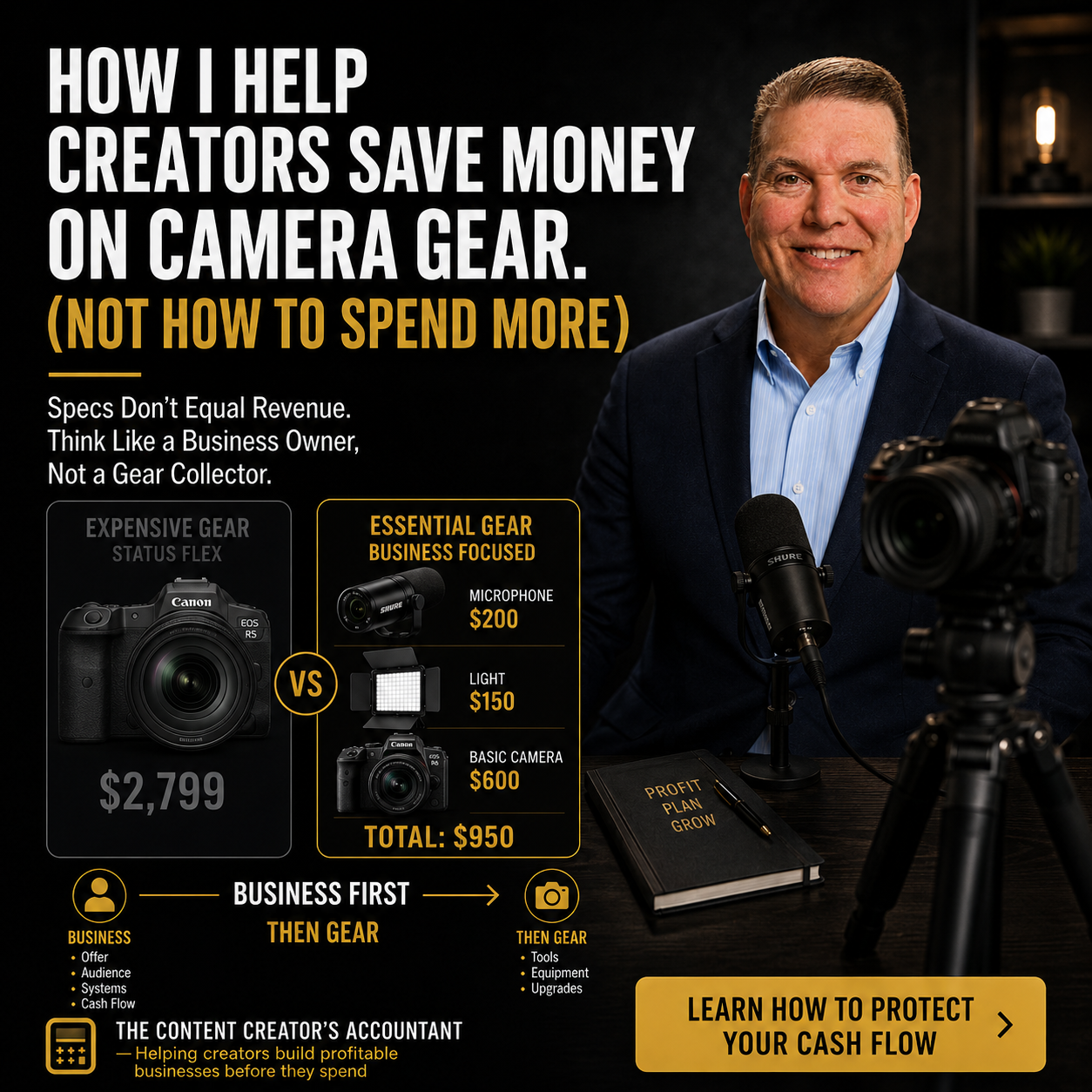
I see this pattern constantly. A creator calls me in Q3 because they're about to drop $2,500 on a new camera, convinced that once they get the "right" gear, everything will change — videos will look professional, clients will sign up, and monetization will kick in. Then I ask one question: "Will this camera help you make more money?" Half the time, they pause because they've been thinking like a gear collector rather than a business owner. How I Help Creators Save Money on Camera Gear (Not How to Spend More)
This post is inspired by a question Canon Rumors raised in their article about YouTube creators: How much camera do you really need? From an accounting standpoint, the answer is not technical. It's financial.
Specs Don't Equal Revenue
Creators get lost comparing sensors, frame rates, autofocus systems, and dynamic range. What they rarely ask is whether any of it moves the needle on revenue.
The Canon EOS R50 V runs $649 body-only. The Canon EOS R6 Mark III runs $2,799. That's a $2,150 gap. Add lenses, memory cards, lights, a microphone, and a tripod, and you're looking at a $5,000+ setup.
For wedding photographers and commercial videographers, that investment makes sense because you're selling the output. For most YouTubers, coaches, educators, and podcasters, the camera is not the bottleneck. I know this because I've tracked expenses for hundreds of creators. The camera is rarely what's holding them back.
What actually is? Poor lighting. Weak audio. Posting once a month. No content strategy. No monetization plan. Spending on gear before the business has revenue to support it.
Ask What Job the Camera Actually Needs to Do
A creator filming talking-head videos for YouTube does not need the same setup as someone shooting weddings. Someone making TikToks does not need what a documentary filmmaker needs.
If you mostly post short-form content, a better microphone, a softbox, and faster editing software might improve your output more than a $2,800 camera body. From a business standpoint, the best equipment purchase is the one that helps you generate income, save time, or deliver better work to paying clients. Not the one with the best specs sheet.
Your stage of business matters too. If you're not making a consistent income yet, your job is to keep costs low and ship content regularly. I've seen creators spend $3,000 on gear before they've posted ten videos. The financial pressure is real, and it kills momentum. Once you're earning consistently and a specific problem is limiting your work, then an upgrade makes sense. Overheating during long recordings, unreliable autofocus, or losing clients over production quality, those are real business reasons to buy.
The Hidden Cost Nobody Talks About
The sticker price is only the beginning.
A $2,799 camera body often means better lenses, larger memory cards, extra batteries, a more powerful computer, and more backup storage. That investment quietly becomes $5,000 or $6,000 before you finish unpacking. And if you don't fully understand the camera, it can slow your whole workflow. Editing takes longer. File organization gets messy. Exports eat hours.
That's where creators quietly lose money. Not just on the hardware, but on the entire system around it.
The Deduction Doesn't Make It Free
This is the biggest misconception I run into.
Yes, a business camera can be tax-deductible if it's ordinary and necessary for your work. The IRS requires both: common in your field and reasonable for your business. But a deduction doesn't mean the camera is free. If you spend $2,800, you spend $2,800. A deduction reduces taxable income; it doesn't put that cash back in your account.
There are also depreciation rules. Equipment may need to be spread across several years, or you may be able to deduct it under Section 179, depending on the specifics. Either way, the better strategy is to buy what your business actually needs, document the business purpose, and keep clean records. Not to buy more gear in hopes of reducing your tax bill.
Before You Buy, Ask These Four Questions
Name the actual problem. Not the camera you want. The problem. Is your audio bad? Are clients pushing back on production quality? Does your current setup slow you down? If you can't name the problem, the purchase is emotional.
Price the full setup, not just the body. Include the lens, lights, microphone, tripod, memory cards, batteries, hard drives, editing software, and insurance. That's the real number.
Figure out how it pays for itself. Will this help you book more brand deals? Charge higher rates? Reduce outsourcing costs? If the camera doesn't have a path to ROI, wait.
Upgrade the weakest link first. For most creators, that's not the camera. A $200 microphone and a $150 light will do more for your content than a $2,800 body swap.
The Real Question
The question isn't "What camera do I want?"
It's "What camera does my business actually need right now?"
If the answer is better, great. If the answer is the same one with better lighting and a proper microphone, that's worth knowing before you spend. Because content creators don't just need gear. They need cash flow, clean books, and a plan for how the money works.
A tax deduction is nice. A profitable creator business is better.

President
Ralph V. Estep, Jr. is a Delaware-based licensed accountant, author, rancher, and media host with more than 30 years of experience in finance, taxation, and small-business leadership. As the founder of Saggio Accounting+PLUS and the creator of the Ask Ralph Media network, Ralph helps entrepreneurs, creators, and everyday families replace money confusion with clarity, confidence, and practical next steps—without shame and without hype.
Ralph’s work blends deep professional expertise with a coach’s mindset and a communicator’s heart. He has held leadership roles across public accounting, financial institutions, law firms, and technology organizations, bringing a rare combination of traditional accounting rigor and modern systems thinking to the people he serves. A graduate of the University of Delaware and Wilmington University (MBA), Ralph is known for turning complex money topics into simple, repeatable frameworks that help people make wiser decisions and build lasting financial stability.
Through Ask Ralph Media, Ralph hosts multiple shows designed to meet people where they are and guide them forward. He is the host of Financially Confident Christian, a daily, faith-based show offering warm, pastoral encouragement for listeners who want peace and practical wisdom with their finances.
He also hosts Truth Unveiled with Ralph, a weekly program that contrasts cultural pressure with biblical truth and invites listeners into deeper spiritual and practical alignment. For small business owners, Ralph leads Grit and Growth Business, spotlighting real sto… Read More

Business Profit vs. Cash Flow: Why You're Profitable but Have No Money in the Bank