The Thing I Said Out Loud This Morning
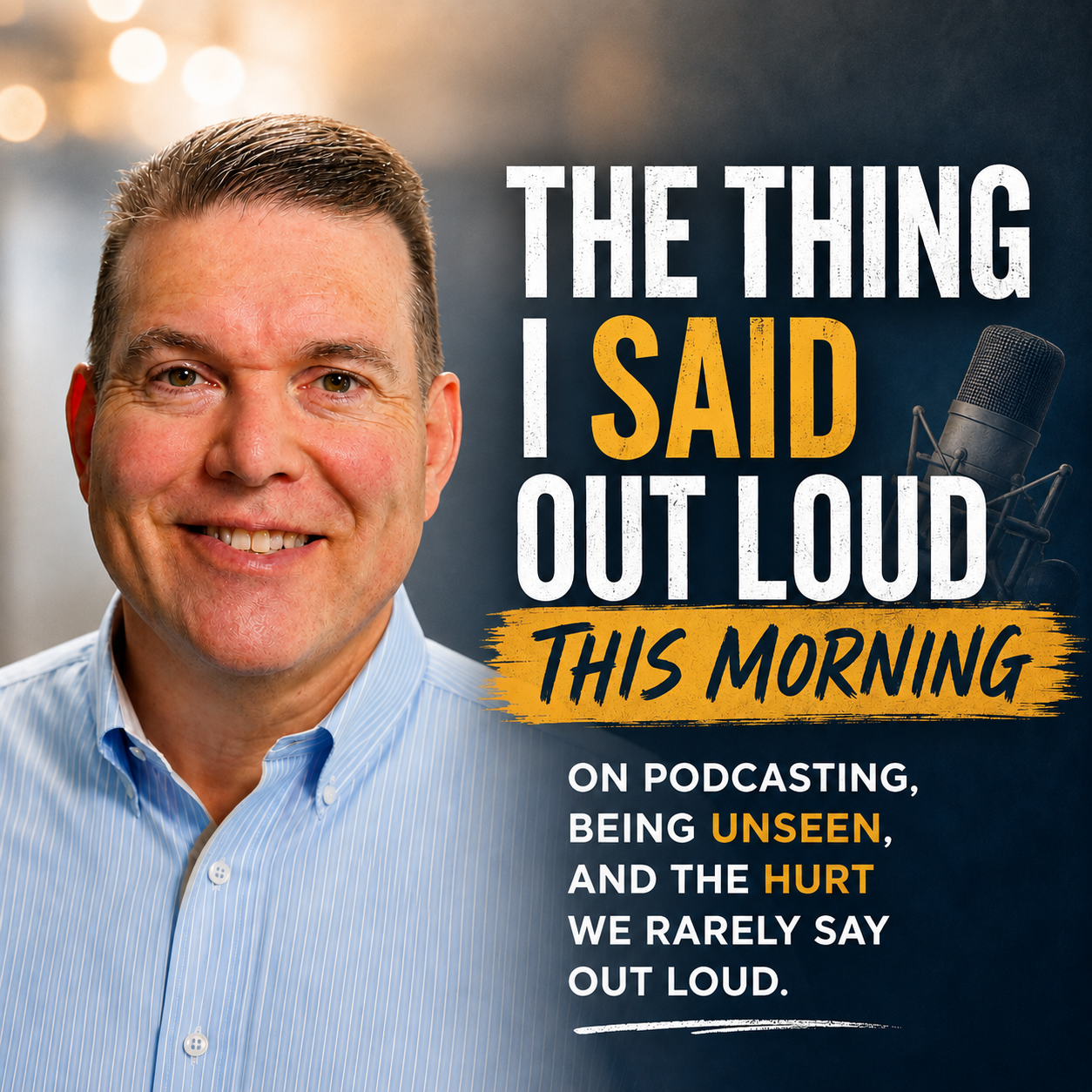
The Thing I Said Out Loud This Morning
I want to start with something I don't usually admit so plainly, even to myself.
This morning, on the show I host, I told a room full of people — and anyone listening — that my wife doesn't support my podcasting. Not in some gentle, "she just doesn't get it, but it's fine" way. I mean she's told me, more than once, that she doesn't care. That all she hears from me is podcasting, podcasting, podcasting, and she's tired of it.
I said it out loud because I'd been carrying it quietly for a long time, and I had a hunch I wasn't the only one. But saying it didn't make the feeling go away. If anything, it sat with me for the rest of the morning, and it's still sitting with me now as I write this.
So I want to use this post to actually sit with it — not to fix it, not to wrap it up with a neat lesson at the end, but to be honest about what it feels like. Because I suspect a lot of you know exactly what I'm talking about, and have never said it out loud either.
The Hurt Underneath the Hurt
Here's what I've noticed when I really sit with this feeling: it's not really about the podcast.
When someone you love says "I just don't care" about something you've poured years into — your time, your money, your creative energy, the parts of yourself you've put on a microphone for strangers to hear — what you actually hear is something much bigger. You hear: I don't see what this costs you. I don't see what it means to you. I don't see you.
That's the part that hurts. Not the podcast itself. The feeling of being unseen by the person whose seeing matters most.
And then right behind that hurt comes something else — guilt, and a strange kind of defensiveness. Because at the same time I feel hurt, part of me also thinks: she's not wrong. This hasn't paid the bills. It does take a lot of hours. I have bought a lot of gear. So now I'm hurt and I feel like I don't have the right to be hurt, which somehow makes it worse.
I don't think I'd fully named that combination until this morning. Hurt, plus guilt, plus the sense that you're not even allowed to feel either one.
The Loneliness of Doing Something Public That Feels Private
There's another layer to this that's strange to explain. I have hundreds of thousands of people who follow what I do. I get messages from strangers telling me my content has helped them. And yet, the person I share a home with doesn't ask about it, doesn't listen to it, and at times has made it pretty clear she'd rather not hear about it at all.
That's a strange kind of lonely — being "known" by people who will never meet you, while feeling unknown by the person across the table. I don't think that loneliness gets talked about much in podcasting circles, because it doesn't sound like a "content creator problem." It sounds like a marriage problem, and so it gets filed away as something private, something you don't bring up on a business call.
But for a lot of us, it's not separate from the work. It's tangled up in it. The success and the loneliness live in the same place, at the same time.
What I Heard When I Asked the Room
When I opened this up this morning, what came back wasn't one story — it was almost every story.
Some people described partners who are genuinely, deeply supportive — who've been on their own version of this journey, even if it's never been public, and who understand exactly what it costs because they've paid a similar cost themselves. Others described something more like quiet tolerance: their partner lets them do it, doesn't ask many questions, and that's the deal they've settled into.
A few people, like me, described real tension — money being a sore spot, feeling like their passion is treated as a waste of time, sensing something close to jealousy when attention comes from strangers instead of from home.
And then there were people further along in this than I am, who said something that stuck with me: this can change. Not because a partner suddenly falls in love with podcasting, but because over time they start to see what it actually is, and how much it means to the person doing it. Someone described it almost like two different animals living side by side — a fish doesn't need to understand what a bird does up in the sky to be glad the bird is happy flying. The relationship doesn't require shared interest. It just requires room for both things to be true: that you have this thing that matters to you, and that it doesn't take anything away from them.
I want that to be true for me. I'm not there yet. But hearing it laid out so plainly, by people who've actually lived both sides of it, gave me something I didn't walk in with this morning — a little bit of hope that this isn't permanent.
The One Thing I Can Actually Do Something About
If I'm honest with myself, there's a piece of this that isn't really about my wife at all — it's about me, and the story I've been telling about this thing I do.
For a long time, in my own head, this has lived in the "thing I love, but that doesn't really count" category. A hobby with a budget. And I think, on some level, if that's how I've been framing it to myself, it's probably how it's landed for her too — as an expensive hobby, not as work, not as a business, not as something with a plan behind it.
That part I can change. Not by convincing her to love podcasting. But by being honest — with myself first, and then with her — about what this actually is: a business I'm building, with a plan, with numbers behind it, with a "why." That's not going to undo years of feeling unseen overnight. But it's a different conversation than "why do you keep buying microphones," and it's one I actually have some control over.
If You're Carrying This Too
If you're reading this and something in it landed — if you've felt that specific mix of hurt and guilt, that loneliness of being known by strangers and unknown at home, that quiet ache when the person you most want to share this with tells you they just don't care — I want you to know you're not the only one. I've sat in rooms with successful, well-known podcasters who carry exactly this, and almost none of us say it out loud.
I don't have a tidy ending for this one. I'm not going to pretend this morning's conversation fixed anything in my marriage, because it didn't. But naming it — really sitting with what it feels like, instead of pushing past it the way I usually do — felt like something. Maybe that's enough for today.
If this is something you're carrying too, you're not alone in it. And maybe that's worth saying, even if nothing else changes.

President
Ralph V. Estep, Jr. is a Delaware-based licensed accountant, author, rancher, and media host with more than 30 years of experience in finance, taxation, and small-business leadership. As the founder of Saggio Accounting+PLUS and the creator of the Ask Ralph Media network, Ralph helps entrepreneurs, creators, and everyday families replace money confusion with clarity, confidence, and practical next steps—without shame and without hype.
Ralph’s work blends deep professional expertise with a coach’s mindset and a communicator’s heart. He has held leadership roles across public accounting, financial institutions, law firms, and technology organizations, bringing a rare combination of traditional accounting rigor and modern systems thinking to the people he serves. A graduate of the University of Delaware and Wilmington University (MBA), Ralph is known for turning complex money topics into simple, repeatable frameworks that help people make wiser decisions and build lasting financial stability.
Through Ask Ralph Media, Ralph hosts multiple shows designed to meet people where they are and guide them forward. He is the host of Financially Confident Christian, a daily, faith-based show offering warm, pastoral encouragement for listeners who want peace and practical wisdom with their finances.
He also hosts Truth Unveiled with Ralph, a weekly program that contrasts cultural pressure with biblical truth and invites listeners into deeper spiritual and practical alignment. For small business owners, Ralph leads Grit and Growth Business, spotlighting real sto… Read More
Estimated Tax Safe Harbor: Why Paying On Time Can Still Leave You With a Big April Bill