Why Content Creators Don't Make Money (The 3-Part Fix)

Why Content Creators Don't Make Money (The 3-Part Fix)
Most content creators think the formula is simple: make good videos, build an audience, watch the money roll in. That's not how it works. I've seen creators with hundreds of thousands of followers making almost nothing because they never built an actual business around their content. They have eyeballs. They don't have a revenue system. This post breaks down the exact gap most creators miss and shows you how to close it.
Content Is Not a Business By Itself
Here's the truth that nobody wants to hear: great camera work, catchy thumbnails, and consistent uploads won't turn your content into income. They'll turn it into a YouTube channel. To actually make money, you need something behind that content that people will pay for.
The difference between a creator and a business owner? A creator makes content. A business owner makes content and then converts attention into dollars.
Your Audience Size Doesn't Equal Your Revenue
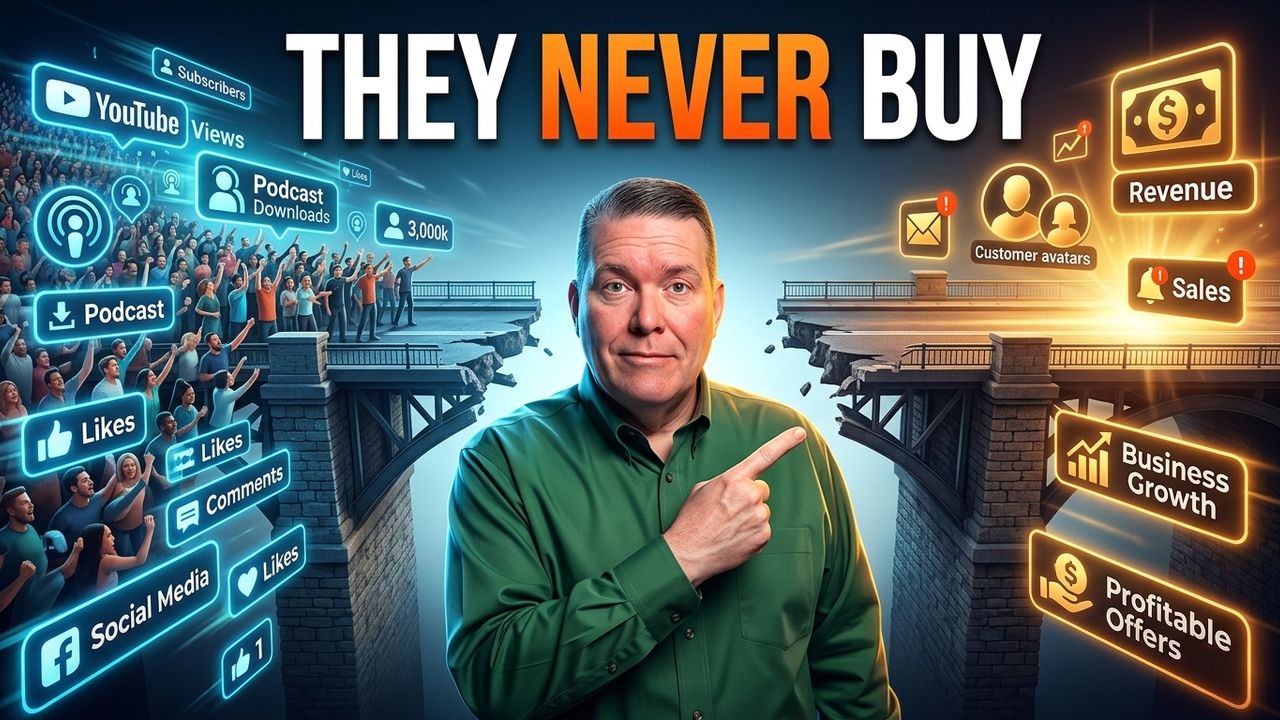
You can have 50,000 subscribers and still struggle financially. You can have 5,000 subscribers and run a six-figure business. Why? Because audience size and business profitability are not the same thing.
Building an audience gets you attention. But attention alone doesn't pay rent. What actually pays is having a clear path for that audience to spend money with you. Most creators stop after step one and wonder why they're still broke.
The Three-Part Monetization Framework
1. Define Your Audience's Real Problem
Stop counting heads. Start identifying who you're actually solving problems for and what those problems are.
Your audience isn't "people interested in X topic." Your audience is the subset of people with a specific problem that your content addresses. A productivity creator's real audience isn't "people interested in productivity." It's "busy professionals losing 10+ hours per week to disorganized systems" or "entrepreneurs feeling scattered and overwhelmed."
Once you know the real problem, you can build offers around it. This is the foundation of everything that comes next.
2. Create an Offer That Solves That Problem
This is where most creators get stuck. They know how to make content, but they don't know how to build an offer.
Your offer doesn't have to be complicated. It can be a course, a coaching call, a workshop, a digital product, a membership, or even a service. What matters is that it directly solves the problem your audience has. If your audience problem is "I don't know how to start a podcast," your offer should solve that. If it's "I'm intimidated by podcasting," your offer needs to address the intimidation, not just the how-to.
The strongest offers also show transformation. Not the feature (what you teach), but the outcome (what changes in their life).
3. Build a Path From Content to Customer
This is the system. You need:
A simple call to action that directs people where to go next. A landing page or link that explains the offer clearly. An email sequence or follow-up system that removes friction. A way to track whether people are actually converting.
Most creators skip this part and hope people will find them. Hope is not a strategy.
Own Your Audience, Don't Rent It
YouTube, Instagram, TikTok, LinkedIn—these are platforms. They're useful for discovery, but they're not your business. The algorithm can change tomorrow and crush your income.
What you need to own is your email list. This is your direct line to your audience that no platform can take away. Every piece of content you make should funnel interested people toward your email list. That's how you build something sustainable.
The Professional Creator Mindset
Amateur creator thinking: "I'll make great content for free and monetize later when I have more followers."
Professional business thinking: "I'll make great content and guide people toward my paid offer from day one."
Amateur creator thinking: "Success is 100,000 followers."
Professional thinking: "Success is $5,000 per month in recurring revenue."
Amateur thinking: "Which platform pays the most?"
Professional thinking: "How do I build an asset I own?"
There's a reason successful creators stop worrying about follower count and start obsessing over conversion rate.
The Missing Piece: Intention
The biggest mistake isn't your content. It's that you're treating content as the goal rather than the vehicle. Every video, every post, every email should have a job. That job is to move someone closer to paying you.
This doesn't mean you become salesy. It means you're honest about what you're building and clear about where people go next. The best creators in every niche do this. The broke ones don't.
What to Do Next
Stop looking at your view counts. Look at your conversion rate instead. For every 100 people who see your content, how many end up on your email list? Of those, how many become paying customers?
If you don't know these numbers, that's why you're not making money.
If you want to fix this fast, consider a content monetization audit to map out your revenue path and pinpoint exactly where people drop off. But at minimum, answer this question honestly: What happens after someone watches your content? Do they have somewhere to go? A reason to give you their money?
If the answer is no, that's what's actually costing you.

President
Ralph V. Estep, Jr. is a Delaware-based licensed accountant, author, rancher, and media host with more than 30 years of experience in finance, taxation, and small-business leadership. As the founder of Saggio Accounting+PLUS and the creator of the Ask Ralph Media network, Ralph helps entrepreneurs, creators, and everyday families replace money confusion with clarity, confidence, and practical next steps—without shame and without hype.
Ralph’s work blends deep professional expertise with a coach’s mindset and a communicator’s heart. He has held leadership roles across public accounting, financial institutions, law firms, and technology organizations, bringing a rare combination of traditional accounting rigor and modern systems thinking to the people he serves. A graduate of the University of Delaware and Wilmington University (MBA), Ralph is known for turning complex money topics into simple, repeatable frameworks that help people make wiser decisions and build lasting financial stability.
Through Ask Ralph Media, Ralph hosts multiple shows designed to meet people where they are and guide them forward. He is the host of Financially Confident Christian, a daily, faith-based show offering warm, pastoral encouragement for listeners who want peace and practical wisdom with their finances.
He also hosts Truth Unveiled with Ralph, a weekly program that contrasts cultural pressure with biblical truth and invites listeners into deeper spiritual and practical alignment. For small business owners, Ralph leads Grit and Growth Business, spotlighting real sto… Read More
The Real Reason Your Podcast Isn't Making You Money