
How to Calculate Your Own Video Threshold
How to Calculate Your Own Video Threshold
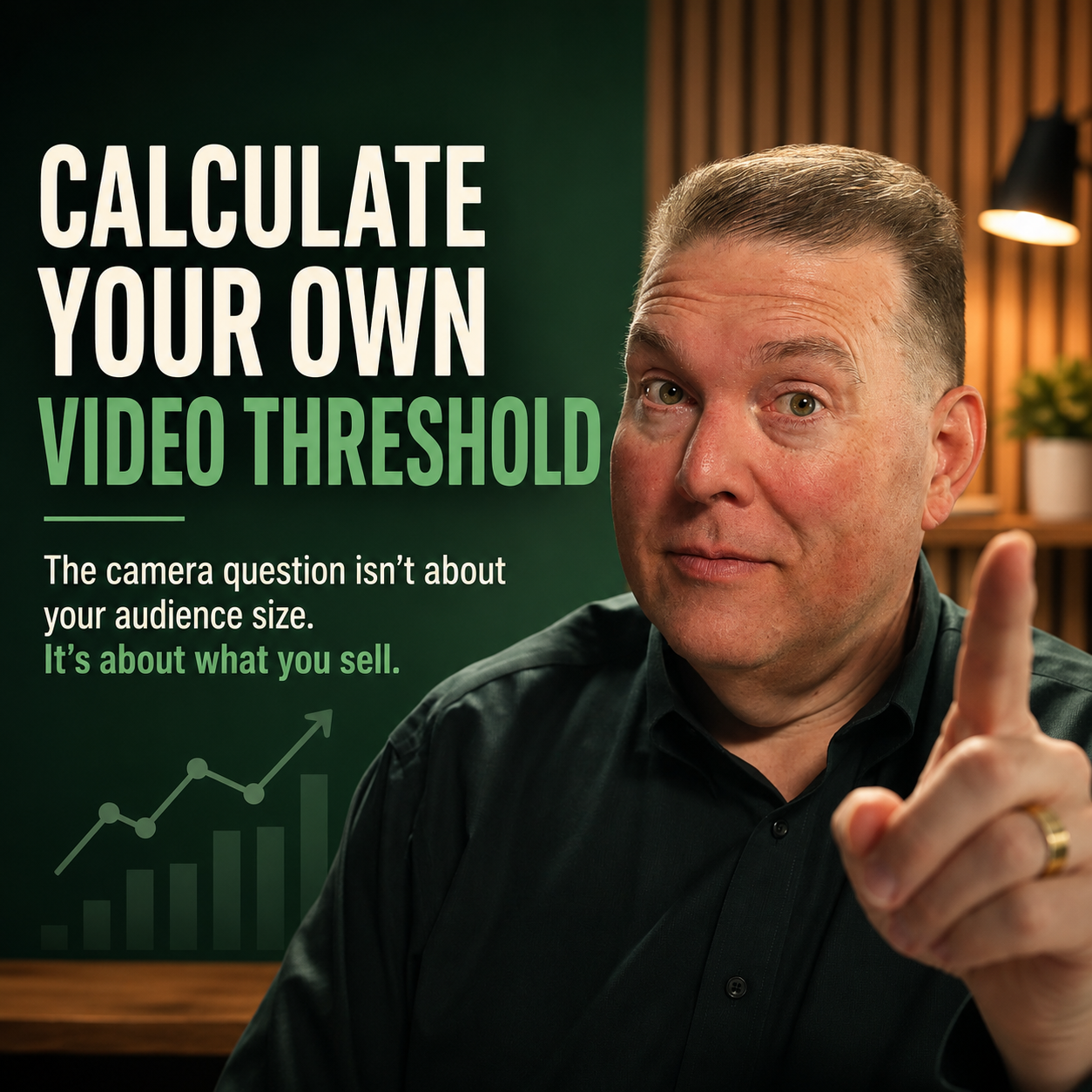
The camera question isn't about your audience size. It's about what you sell.
By Ralph Estep Jr., LPA, The Content Creator's Accountant
Disclosure before I start: The Content Creator's Accountant is a supporter of Podnews, whose reporting I draw on below.
Every week somebody asks me some version of the same question. Should I be doing video?
And every week I have to tell them I can't answer it, because they've asked me a question about cameras when the thing they actually need is a number they don't have.
This week somebody finally built the framework for getting that number. So let's use it.
What Losh Moodaley named
On July 27, Podnews published Losh Moodaley's essay "The Price of Visibility: The Hidden Economics of Podcast Video." Moodaley works in direct sponsorship revenue for independent shows, which is exactly why she had data when the rest of the industry had opinions.
Her argument, briefly. For an independent creator, video isn't a content format. It's a customer acquisition channel, and like any acquisition channel it has to earn back what it costs. That means every podcast business has a point where video flips from a cost the creator personally absorbs into an investment the business funds. She calls that point the Video Threshold, and she says it's set by three things: what production costs, what a customer is worth to you, and how your show makes money.
Then she went and got the costs. Drawing on the Podcast Marketing Academy and Lower Street "Audio vs. Video Podcasting: The Cost of Attention" report, she shows that adding video takes average monthly production from $388 to $1,267, and per-episode cost from $67 to $244. Cost per listener-hour climbs from roughly 56 cents to 99 cents.
And her conclusion is the sentence I wish I'd written. She argues that a successful podcast business is what "creates the conditions that make video a rational investment," not the reverse.
That's correct, and it's the most useful thing published on creator economics this month. Go read the whole piece.
What I want to do here is take her framework and show you how to run it on your own business, because the number that matters isn't hers. It's yours.
The formula
Forget download counts for a minute. The question is not how big your audience is. The question is whether the additional money video costs you comes back.
So we work in incremental terms, the way you'd evaluate any capital decision.
Two inputs. Let's get both.
Input one: what video actually adds to your costs
Using Moodaley's figures, going from audio-only to video takes you from $388 a month to $1,267. The incremental cost, the new money, is $879 a month. That's the number that has to earn its way back. Not the whole $1,267. You were already spending the $388.
Now, I asked Moodaley what sits inside that $1,267, because it changes entirely how you should apply it. Her answer is worth more than the number itself.
It is ongoing operational spend, and it excludes capital equipment. The survey asked creators for their average monthly production budget. Cameras, lenses, lighting grids, acoustic panels, switchers, none of that is in there.
And the jump isn't gear. It's people. Per the underlying report, video shows use agency support at a rate 600% higher than audio shows, carry 63% more full-time staff, and use 29% more part-time help. Sets have to be built and reset, multitrack video has to be edited and rendered, thumbnails have to be made, and the whole thing has to be uploaded and optimized across YouTube, Spotify, and social, every single week. Audio RSS distribution asks for none of that.
There's a detail buried in there that I found genuinely surprising: video hosts report spending slightly less personal time on production than audio hosts. Not because video is easier. Because they've paid someone else to absorb it.
Which tells you exactly how to build your own version of this number. Three adjustments.
Add your capital back, separately. Since her figure excludes equipment, you have to layer it on. A $2,000 studio build isn't a $2,000 monthly expense either. Depreciated straight-line over 36 months it's about $56 a month, and in month 37 it's zero. Keep it on its own line so year one doesn't look like forever. Depending on your structure, some of that spend may be deductible far more aggressively in the year you buy it. That's a conversation for your own tax professional, but the analysis point holds regardless.
Count your own hours, because the survey didn't. Moodaley was explicit that host labor sits outside the figure. If you edit your own video, your cash outlay looks smaller and your real cost isn't. Six added hours a month at $150 an hour is $900 that never appears on an invoice. It's still spend. This is the single biggest way solo creators fool themselves into thinking video is cheap.
Count only what's new. If you were already paying an editor, only the increase belongs in the incremental number.
Input two: what one additional listener is worth to you
This is the input almost nobody has, and it's the one that decides everything.
Contribution per additional listener is the gross profit you earn, on average, from one more person entering your world. Not revenue. Contribution, after the cost of delivering whatever they bought.
The formula for any given offer.
Add it up across everything you sell. And if you're monetizing with ads instead, contribution per listener is simply your CPM divided by a thousand.
Three creators, same cameras, wildly different answers
Here's why this matters. Below are three creators facing the identical $879 monthly decision. The conversion rates and prices are my illustrations, not survey data, but plug in your own and the shape of the answer holds.
Creator A monetizes with programmatic advertising only. At the roughly $6 CPM Moodaley's video figures imply, each additional play contributes six-tenths of a cent. To cover $879 a month, Creator A needs about 146,500 additional plays a month, roughly 36,600 an episode at four episodes a month.
Creator B sells a $15/month membership. Say two-tenths of one percent of new listeners join, they stay about a year, and the margin is 90%. Each additional listener contributes about 32 cents. Creator B needs roughly 2,700 additional listeners a month, about 680 an episode.
Creator C sells a $1,200 course at an 80% margin and converts half of one percent of new listeners. Each additional listener contributes $4.80. Creator C needs 183 additional listeners a month. About 46 an episode.
Same cost. Same content. Same cameras in the same room.
Creator A needs roughly eight hundred times the audience Creator C does.
That's the whole thing. Not talent, not gear, not thumbnails. The denominator.
And be honest with yourself about the inputs. If Creator C converts at one-tenth of a percent instead of half, the requirement jumps from 183 listeners to about 920. Still a fraction of what Creator A needs, but the sensitivity is the point. Small changes in conversion move this number more than large changes in audience.
Two adjustments most people miss
Count both your feeds. If you produce video, you almost certainly still have an audio RSS feed, and those listeners don't evaporate when the camera turns on. When you calculate what video returns, count the audience and revenue on both sides of the house. It's easy to model video as though it replaces your audio business rather than sitting alongside it, and that understates the return.
Video does two jobs, not one. It acquires people who'd never have found you. That's marketing. It also converts people who already found you, because seeing your face is what makes a stranger comfortable enough to buy a $2,000 engagement. That's sales. I've watched this in my practice for thirty years, long before anyone said "creator." People buy from people they've looked in the eye. If video is lifting your close rate on an offer you already sell, charging all of it against acquisition will make a profitable investment look like a failure on paper.
Misclassify a line item and you'll talk yourself into cutting the thing that was working.
Which is exactly Moodaley's point
She found something in the underlying data that deserves more attention than it's getting: shows producing both audio and video reported customer lifetime values more than 2.6 times higher than audio-only shows.
And here she does the honest thing, which I want to name because most writers wouldn't have. She explicitly declines to claim video caused those higher lifetime values. She argues the reverse, that businesses already capable of generating high customer value are the ones that can justify video sooner. That's the harder reading to sell and it's the correct one. Worth knowing when you weigh the figure: it's self-reported survey data, so the shows answering questions about production economics aren't a random sample.
Which lands us in the same place from two directions. She got there from the cost side. I teach it from the revenue side as the Creator Revenue Formula, Audience × Problem × Offer = Value. Audience alone is a number. Multiply it by a problem worth solving and an offer that solves it, and only then does it become a business that can afford cameras.
If you can't fill in "contribution per additional listener," you cannot answer the video question. Not because you lack courage or gear. Because you're missing the denominator.
What that "10 of 200" number actually measures
Moodaley's piece opens with a striking figure: only 10 of the top 200 US podcasts offer video. It's been quoted all week, and I'd bet most of the people repeating it don't know what it counts.
It comes from Bloomberg's June 25 analysis of Apple Podcasts' video push, and the scope is specific: it looks at the top 200 shows on Apple Podcasts' US chart, and at whether those shows offer video on Apple. The finding is that on the biggest audio platform actively pushing video, 95% of the top creators haven't taken it up.
That's a meaningfully different claim from "the top 200 podcasts don't do video," which is how it's traveling. Plenty of those shows have thriving YouTube channels. What the number says is that they haven't followed Apple into Apple's version of video, which tells you something about where video actually pays off, and it isn't inside podcast apps.
Worth getting right before you quote it on your own show.
I'm not the only one saying this
Adam Schaeuble has been teaching this since 2018 on Podcasting Business School, and his own origin story is the argument in miniature. He built a real listener base on his first podcast and, by his own account, earned $37 across three years. The audience wasn't what was missing. The offer was.
And on Creator Science, Jay Clouse recently hosted Eric Zimmer of The One You Feed, twelve years, 850-plus episodes, a three-person team, who is mostly skipping video on purpose and moving away from ad revenue toward serving fewer people more deeply. Not a creator who can't afford cameras. A creator who landed in the same place from a different road.
Different rooms, same conclusion. The people actually making money in this business aren't arguing about cameras. They're arguing about what each listener is worth.
The bottom line
Run the two numbers. Incremental monthly cost of video, divided by contribution per additional listener. If you can't produce the second one, that's not a reason to feel bad about yourself. It's your next project, and it's a more valuable one than any camera you could buy this month.
Because here's where I land.
Video is not good or bad. It's not brave or cowardly. It's not a referendum on whether you're a real creator.
It's a line item.
And a line item you can't measure is just a hobby with a receipt.
Ralph Estep Jr. has been a licensed public accountant for over 30 years and hosts The Content Creator's Accountant. If you'd like help finding your own contribution per listener and your own threshold, apply for a creator audit.
APPLY FOR A CREATOR AUDITNothing here is tax, legal, or investment advice for your situation. Depreciation treatment, deduction elections, and entity structure vary enormously. Talk to your own professional before acting on any of it.
Sources
- Losh Moodaley, "The Price of Visibility: The Hidden Economics of Podcast Video," Podnews, July 27, 2026, podnews.net/article/the-video-threshold
- Podcast Marketing Academy and Lower Street, "Audio vs. Video Podcasting: The Cost of Attention," podnews.net/press-release/video-vs-audio-podcasting
- Adam Schaeuble, Podcasting Business School, Apple Podcasts
- Adam Schaeuble profile, The Tilt, thetilt.com
- Jay Clouse, Creator Science, podcast.creatorscience.com
Cost figures are Moodaley's, from the Podcast Marketing Academy and Lower Street report. The threshold calculations and the three creator examples are original, built on her framework. Conversion rates, prices, and margins in those examples are illustrative and stated inline.

President
Ralph V. Estep, Jr. is a Delaware-based licensed accountant, author, rancher, and media host with more than 30 years of experience in finance, taxation, and small-business leadership. As the founder of Saggio Accounting+PLUS and the creator of the Ask Ralph Media network, Ralph helps entrepreneurs, creators, and everyday families replace money confusion with clarity, confidence, and practical next steps—without shame and without hype.
Ralph’s work blends deep professional expertise with a coach’s mindset and a communicator’s heart. He has held leadership roles across public accounting, financial institutions, law firms, and technology organizations, bringing a rare combination of traditional accounting rigor and modern systems thinking to the people he serves. A graduate of the University of Delaware and Wilmington University (MBA), Ralph is known for turning complex money topics into simple, repeatable frameworks that help people make wiser decisions and build lasting financial stability.
Through Ask Ralph Media, Ralph hosts multiple shows designed to meet people where they are and guide them forward. He is the host of Financially Confident Christian, a daily, faith-based show offering warm, pastoral encouragement for listeners who want peace and practical wisdom with their finances.
He also hosts Truth Unveiled with Ralph, a weekly program that contrasts cultural pressure with biblical truth and invites listeners into deeper spiritual and practical alignment. For small business owners, Ralph leads Grit and Growth Business, spotlighting real sto… Read More
How Much Should You Pay Yourself From Your Business? Do the Math in This Order