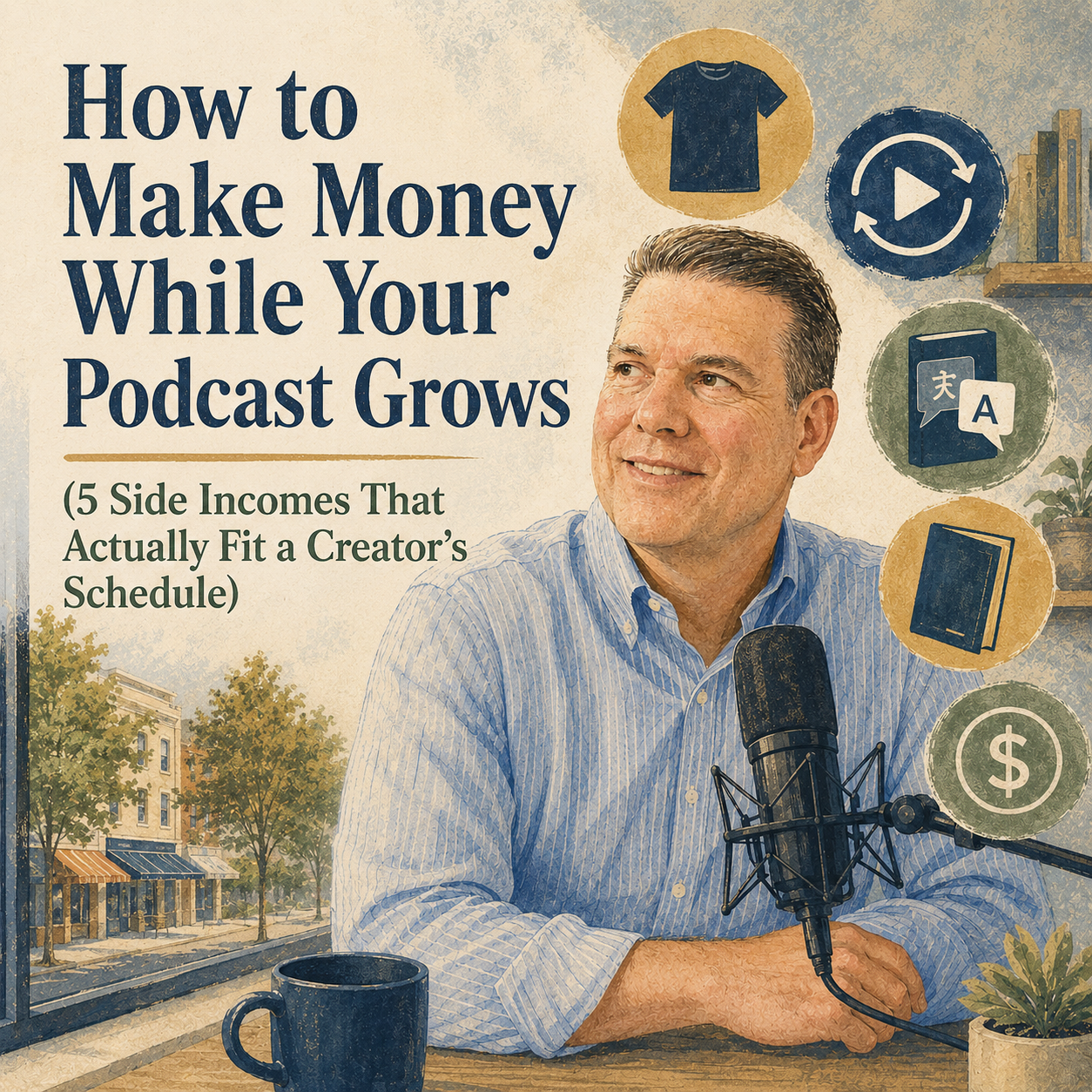
How to Make Money While Your Podcast Grows (5 Side Incomes That Actually Fit a Creator's Schedule)
Most podcasting advice skips the part nobody wants to say out loud: your show might be worth building and still not be paying you yet, and neither of those things means you're failing. What it means is that you need a bridge — a way to make money while your podcast grows a way to keep the lights on while you build the trust that eventually turns listeners into clients and revenue. The creators I've watched burn out didn't quit because their content was bad. They quit because they couldn't find side incomes that actually fit a creator's schedule long enough to win. That's the problem I want to solve today.
The Honest Math on Podcast Income
Most podcasters aren't ready to hear this, but the numbers matter.
Ad networks won't look at you until you're hitting 5,000 to 10,000 downloads per episode. Below that, programmatic ads might pay $3 to $15 per thousand listeners. A show with 1,000 downloads per episode running those ads earns about $10 per episode. Four episodes a month. Forty dollars.
That's not a business. That's a hobby with extra steps.
Now — that doesn't mean your show isn't valuable. The whole premise of Audience Economics (the framework I use with every creator I work with) is that a small, deeply engaged audience is worth more to the right business than a massive passive one. A thousand people who trust you enough to act on your recommendations will outperform a hundred thousand who scroll past.
But Audience Economics takes time to build. And while you're building it, your bills don't wait.
That's where side income comes in. Not as a fallback. Not as a sign that podcasting doesn't work. As a strategic decision to buy yourself the one thing every creator needs:
Time.
5 Side Income Streams That Work Around a Recording Schedule
A Forbes report published this month identified five online side careers picking up real momentum in 2026. What caught my attention — as an accountant who works specifically with content creators — is how well these five fit around a content schedule. They're not second jobs. They're income streams you can run in the margins of the work you're already doing.
1. Virtual Assistance
The VA market is growing at nearly 25% per year. The workforce is projected to grow from 3.9 million in 2020 to 8.4 million by 2028. Freelance VAs earn between $13 and $67 per hour, with annual averages around $32,000 to $36,000.
Here's what makes this a natural fit for podcasters: you already know the tools. Notion. Google Workspace. Social scheduling platforms. Email management. Content calendars. These are the exact skills businesses are paying for — and you built them just by running your own show.
You don't need a certification. You need a client. Start with five to ten hours a week and scale up or down around your recording schedule. It bends to you.
2. Print-On-Demand
Print-on-demand is on track to hit nearly $57.5 billion by 2033. The average creator in this space earns around $4,965 per month, with top performers clearing over $10,000 monthly. Profit margins typically run 20 to 40 percent.
The model: you create a design, upload it to a platform like Printful or Printify, and a third-party supplier handles manufacturing and shipping. No upfront inventory cost. No fulfillment headaches.
The creator-specific opportunity most people miss: your audience already trusts your brand. A t-shirt, mug, or notebook tied to your show isn't a distraction from your content — it's an extension of it. And it earns while you're recording, editing, or sleeping.
3. Freelance Translation
Despite the rise of AI translation tools, businesses still rely on human linguists for culturally accurate output. Demand is strong right now for Japanese, Mandarin, and German speakers. General translation work pays $23,769 to $42,608 annually. Legal and medical specializations command $63 to $106 per hour.
If you're bilingual, you may be sitting on a monetizable skill you've never thought of as income.
Longer-term, this one has a creator angle worth naming: if you ever want to expand your show's reach to a global audience, being embedded in translation communities puts you ahead of the curve. You're not just earning — you're building relationships in markets you may want to enter.
4. Selling Digital Products
This one is the most direct fit for what you're already doing as a creator.
If you have specialized knowledge — in personal finance, fitness, business, cooking, content strategy, anything — you can package that expertise into ebooks, templates, online courses, or toolkits. The Forbes data shows top creators earning over $53,715 in a single quarter from digital products. Full-time digital entrepreneurs earn between $52,400 and $87,200 annually.
Here's the Audience Economics point I want to make clearly: you do not need a large following to make this work. Sales can be driven through targeted search, email marketing, and niche communities. The same small, trusting audience that's harder to monetize through ads is perfectly positioned to buy a product you've built specifically for them.
You're already creating content. A digital product is just that content packaged in a way people will pay for directly.
5. Evergreen Background Video
This one surprises people, so stay with me.
Long-form ambient content — fireplace loops, rain sounds, Lo-Fi study music, white noise tracks — is generating high passive income on YouTube and Spotify. One fireplace video has reportedly generated over $1.2 million in ad revenue. Top Lo-Fi creators are pulling in over $29,538 per month. You record once, upload once, and it earns for years with no maintenance.
For podcasters, the barrier here is lower than you'd think. You already understand audio quality. You already have recording equipment. Royalty-free materials make the content side even simpler.
It's not glamorous. But $29,000 a month while you sleep tends to grow on you.
The Real Point
These five income streams are not a replacement for building your show. They are a financial strategy — a deliberate decision to fund the long game while you play it.
Pick one that fits your existing skills. Build it to a number that covers your basics. Use that stability to keep showing up for your audience — consistently, without the desperation that comes from needing every episode to go viral.
That's how you build something that lasts.
What's Your Next Step?
If you're serious about turning your content into a real revenue engine, start by understanding what each member of your current audience is worth to your business. That's the foundation of the Audience Economics framework I use with every creator I work with.
You can start with a free Content Monetization Audit — it's designed to show you where the real income potential in your show actually lives.
Get your free Content Monetization Audit at ContentCreatorsAccountant.com/audit
Ralph Estep Jr. is a Licensed Public Accountant and business coach with over 30 years of experience. He hosts The Content Creator's Accountant podcast and founded Saggio Management Group in Middletown, Delaware in 2005.

President
Ralph V. Estep, Jr. is a Delaware-based licensed accountant, author, rancher, and media host with more than 30 years of experience in finance, taxation, and small-business leadership. As the founder of Saggio Accounting+PLUS and the creator of the Ask Ralph Media network, Ralph helps entrepreneurs, creators, and everyday families replace money confusion with clarity, confidence, and practical next steps—without shame and without hype.
Ralph’s work blends deep professional expertise with a coach’s mindset and a communicator’s heart. He has held leadership roles across public accounting, financial institutions, law firms, and technology organizations, bringing a rare combination of traditional accounting rigor and modern systems thinking to the people he serves. A graduate of the University of Delaware and Wilmington University (MBA), Ralph is known for turning complex money topics into simple, repeatable frameworks that help people make wiser decisions and build lasting financial stability.
Through Ask Ralph Media, Ralph hosts multiple shows designed to meet people where they are and guide them forward. He is the host of Financially Confident Christian, a daily, faith-based show offering warm, pastoral encouragement for listeners who want peace and practical wisdom with their finances.
He also hosts Truth Unveiled with Ralph, a weekly program that contrasts cultural pressure with biblical truth and invites listeners into deeper spiritual and practical alignment. For small business owners, Ralph leads Grit and Growth Business, spotlighting real sto… Read More
How to Build a Content Creator Business That Actually Pays You