You Don't Need a Bigger Audience. You Need This Formula.
You Don't Need a Bigger Audience. You Need This Formula.
Let me tell you something that might sting a little.
Most content creators are sitting on $10,000 right now. Not someday. Right now, inside the audience they already have. And most of them are doing everything right: showing up consistently, publishing, serving their people. Still making nothing.
Not because the money isn't there. Because nobody ever showed them where to look.
That's what this post is about.

The belief that's keeping you broke
There's one idea I hear from creators constantly, and it's the thing holding most of them back. It sounds completely logical. That's what makes it so dangerous.
The belief is this: I need more people to make more money.
So they chase downloads. They obsess over subscriber counts and view numbers. And it keeps them at zero. I've watched creators with 50,000 downloads walk away with nothing. I've also watched creators with 1,000 engaged listeners walk away with $10,000. The difference was never the size of the audience.
The formula that changes everything
I've been coming back to this for the past few weeks because it matters that much.
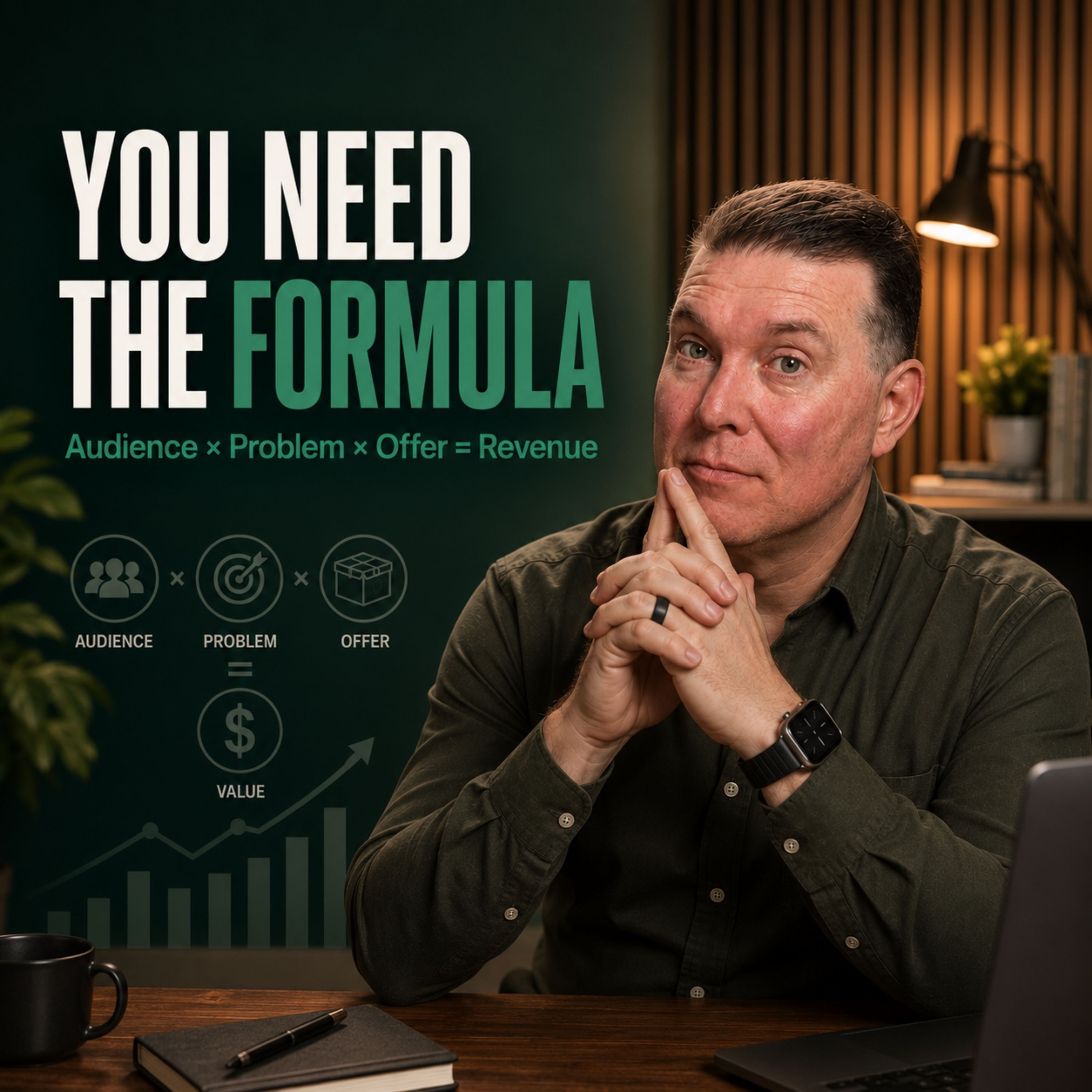
Audience times Problem times Offer equals Value.
Write that down. Audience x Problem x Offer = Value.
Here's why the "times" matters. It's multiplication, not addition. If any one of those three factors is zero, the whole thing is zero. That's the creator with 50,000 downloads who makes nothing. Big audience, real problem, no offer. Audience times Problem times zero is zero. They didn't have an audience problem. They had an offer problem. And that can be fixed this week.
Who's actually in your audience?
Not everyone in your audience is going to buy from you, and that's fine. Here's how to think about the three groups sitting in your feed right now.
Tier 1 is your consumers. They listen, they watch, they learn. They probably won't pay for anything, and that's okay. They're still part of what you're building.
Tier 2 is your learners. These are the people who want more. They want tools, resources, and guidance. This is where digital products start to make sense.
Tier 3 is your action takers. These are people with urgency. They'll pay for speed. They'll pay for clarity. They'll pay to have someone in their corner. And here's the thing: you don't have to convince them. They're already waiting. You just never opened the door.
What's the fastest path to $10,000?
It's not a course. It's not going viral. It's services, consulting, and coaching. And the math is a lot smaller than most people expect.
Five people at $2,000 is $10,000. Ten people at $1,000 is $10,000.
I already know what the voice in your head just said. "Who am I to charge $2,000?" Stay with me on that.
Why does $2,000 feel expensive when it isn't?
Because you're thinking about the price. Your buyer is thinking about the return.
Say you work with an entrepreneur in your audience and you help them fix their pricing model. If they add $2,000 a month from that work, your $2,000 fee paid for itself in 30 days. You didn't take money from them. You multiplied it. That's not a cost. That's the best investment they'll make all year.
When you see it that way, the guilt fades.
So why haven't you done this yet?
Honestly, it's usually not a lack of information. You know what to do. The problem is the feeling in your gut.
"It feels salesy." "I'll ruin the trust I've built." "Who am I to charge that?"
Here's what I want to tell you. None of those feelings make you a fraud. They make you someone who cares about the people listening to you. But staying quiet doesn't protect your audience. It abandons the people who needed help and couldn't find the door. Making an offer isn't taking from them. It's serving on purpose.
Start smaller than you think you have to
Nobody said you have to open with a $2,000 offer tomorrow. If that feels like a cliff, don't jump. Start with a $200 strategy call. Get one yes. Then another. Confidence comes from proof, not pep talks. Small offer, real result, then you climb.
There's no shame in starting small. There's only shame in staying invisible.
Four steps you can take this week
Once the offer works at a small scale, you scale it. Courses, templates, frameworks, guides. You serve more people at a lower price without giving away more of your time. The order matters though: prove it with real people first, then package it. Never the other way around.
Here's where to start this week.
Find your top 10%, the most engaged people in your audience. Those are your buyers. Name their problem out loud, specifically. That's your Problem factor. Build one small offer: a call, a session, a starter package. That's your Offer factor. Then make the invitation. If you never make the offer, they can never say yes.
That's the whole formula in motion
Grab the free worksheet
I built a one-page worksheet to go with these four steps. It's called "Find Your First $10K Offer." It walks you through each step with blanks to fill in. By the time you're done, you'll have an actual offer written down on paper, not a someday idea.
Get it free at ContentCreatorsAccountant.com/10k. Fill it in before you go to bed tonight.
Ready for a second set of eyes?
If you'd rather work through this with me personally, I do Content Monetization Audits. I'll show you where your $10,000 is hiding, which offer fits your audience, and exactly how to open the door.
Apply at ContentCreatorsAccountant.com/audit.
You don't need a bigger audience. You need an audience, a problem, and an offer. Odds are you already have two of the three. The only thing missing is the offer you've been afraid to make.
You can do this. I've watched people with far less figure it out.
Ralph Estep Jr. is a licensed public accountant and business coach with 30 years of experience. He hosts The Content Creator's Accountant podcast, where he helps creators stop leaving money on the table.
President
Ralph V. Estep, Jr. is a Delaware-based licensed accountant, author, rancher, and media host with more than 30 years of experience in finance, taxation, and small-business leadership. As the founder of Saggio Accounting+PLUS and the creator of the Ask Ralph Media network, Ralph helps entrepreneurs, creators, and everyday families replace money confusion with clarity, confidence, and practical next steps—without shame and without hype.
Ralph’s work blends deep professional expertise with a coach’s mindset and a communicator’s heart. He has held leadership roles across public accounting, financial institutions, law firms, and technology organizations, bringing a rare combination of traditional accounting rigor and modern systems thinking to the people he serves. A graduate of the University of Delaware and Wilmington University (MBA), Ralph is known for turning complex money topics into simple, repeatable frameworks that help people make wiser decisions and build lasting financial stability.
Through Ask Ralph Media, Ralph hosts multiple shows designed to meet people where they are and guide them forward. He is the host of Financially Confident Christian, a daily, faith-based show offering warm, pastoral encouragement for listeners who want peace and practical wisdom with their finances.
He also hosts Truth Unveiled with Ralph, a weekly program that contrasts cultural pressure with biblical truth and invites listeners into deeper spiritual and practical alignment. For small business owners, Ralph leads Grit and Growth Business, spotlighting real sto… Read More

Estimated Tax Safe Harbor: Why Paying On Time Can Still Leave You With a Big April Bill