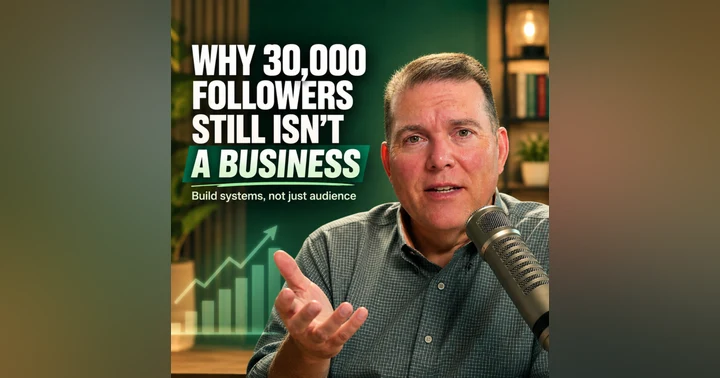
The Business Model Every Creator Needs
Key Takeaways
- Building a social media channel or podcast without owning the underlying customer relationship means you are building your business on rented land.
- Content and audience attention alone do not constitute a real business model without a clear offer and predictable revenue.
- You can test if you truly own your audience by asking whether you can reach them directly at any time without asking a platform's permission.
- A strong creator business model relies on four connected layers: content, audience, a defined offer, and consistent revenue.
- An effective offer is not a tip jar or vague availability; it clearly states a specific problem, a tangible result, and a price.
The Business Model Every Creator Needs challenges you to think beyond your content and consider whether you are actually building a business you own. What would happen if your podcast, YouTube channel, or social media accounts disappeared tomorrow? If your income disappeared with them, you may be building on rented land rather than creating a business with lasting value. In this episode, I explore why audience growth and platform visibility are not enough to create financial security and why every creator needs a business model that can stand on its own.
Check out the full podcast episode here
I walk you through the key steps to turn your content into a real business by building revenue streams, owning your audience relationships, and creating offers that provide value beyond the platforms where you publish. My goal is to help you move from simply creating content to building an asset that can generate income even when algorithms change or platforms disappear. If you want your creator business to be resilient, profitable, and truly yours, this message will help you start building the foundation.
Takeaways:
- If your content disappeared overnight, would your business still survive? It's worth asking.
- Many creators think they have a business when they actually have a channel built around someone else's platform.
- Owning the relationship with your audience is essential for building long-term stability and independence.
- Relying entirely on platforms means your revenue can disappear when the platform, algorithm, or audience access changes.
- Content alone is not a business model; you need clear offers that turn your expertise into sustainable revenue.
- A strong creator business is built on assets, systems, and revenue streams you actually control.
- The goal isn't just to build an audience—it's to build a business that can survive beyond the platforms that helped you grow.
Links referenced in this episode:
Companies mentioned in this episode:
- Vine
- KIT
- ConvertKit
- Alex Hormozi
- Justin Welsh
- Jay Clouse
Ready to take your content to the next level?
Join my Creator’s Inner Circle and get access to weekly Action Sheets, coaching sessions, and early episode releases — everything you need to grow your creator business with clarity and confidence.
Sign up at contentcreatorsaccountant.com/join
Frequently Asked Questions
What is the difference between a creator channel and a creator business?
A creator channel consists of social media platforms, podcasts, and audience attention, which can disappear overnight. A creator business owns the audience relationships, has structured offers, and generates predictable revenue independently of platform algorithms.
Why isn't content creation alone a sustainable business model?
Content creates attention and builds trust, but it acts only as the doorway rather than the house. Without a product, service, or offer to solve a specific problem, high view counts and follower numbers will not automatically translate into income.
How can content creators stop building on rented land?
Creators can stop relying entirely on rented platforms by capturing direct audience connections through owned assets like an email list or customer database, allowing them to reach their audience without platform permission.
What elements make up a successful creator offer?
A strong creator offer must clearly name the specific problem your audience is facing, define the exact result or transformation you are providing, and clearly state the price.
00:00 - Untitled
00:17 - The Consequences of Losing Digital Presence
04:35 - Understanding the Creator Business Pyramid
07:12 - The Importance of Offers in Building Revenue
12:32 - Building a Business from Content Creation
17:01 - The Importance of Offers in Creator Success
19:01 - Building a Revenue System
Speaker A
If your content disappeared tomorrow, would your business survive? I'm talking no podcast, no YouTube, no social media, all of it gone overnight. And I don't want to hear you'd be sad.The question is, would you get paid next month? Most creators wouldn't. Because you don't have a business, you have a channel.And today I'm going to show you the exact model that turns one into the other. Going to be a great episode today. Foreign. I'm a licensed accountant, been doing this for 30 years. I'm a business coach.And yes, I'm the content creators accountant, and I help creators just like you build real businesses, not just build audiences. Because I've seen the books behind the brands, I've seen the big audience, the small deposit, and I see it constantly.All right, well, here's how today's episode is going to work. First, we're going to talk about why the ground underneath you is rented. We got to start by understanding that you're on rented ground.Then I'm going to show you the four level model that fixes that rental issue. And then we're going to do a real audit so you can score yourself where you can bring your own numbers to this one today.Now, as I walk through this, I want you asking one question, and this is the question of the day. Which level am I actually living on now? Which level am I actually living on now? But let's get to today's big idea. Our content is the doorway.It's not the house. We're going to build the house today. But let's talk about the first thing we mentioned. Most of us are built on rented land.Most creators are building on that rented land stuff. We don't own platforms, we don't own algorithms, we don't control audiences that don't fully access what we're doing.And those risks are real and they're sudden. And we've seen it time and time again. That algorithm can change overnight and your audience is gone.Maybe your account gets suspended or imagine it getting hacked, then it's gone. Or a whole platform fades away. Remember Vine? It's gone. Or maybe a policy is updated that you never voted on.And the problem with all of this, when the land is rented, the money is rented, too. The ad revenue, you're counting on, those platform funds, and even your sponsors are all paid by someone who can stop paying at any moment.And so many of you think this is my business, but what it really is is a distribution channel. And if that channel disappears and it's. It's happened to so many of us. So does your income. So how do we fix that?Well, number one thing we've got to do, we've got to own the connection. When I talk to content creators, the number one thing I tell them is, you got to own the connection. That's the fix for this rented land.Own the connection. Now, what does that look like? It looks like an email list, a customer list, something that you can control. Here's the test.Can you reach them Tuesday at 9am without asking anyone's permission? And that's a tough question to answer. If the answer is no, guess what? You don't own it. You're on rented land.You have followers live on the platform, and your customers, though, live in your business. And if you can only reach your audience when the algorithm allows it, you don't really have access to.You have permission, and someone else is in control of granting that permission. So starting today, let's make one place to send them that you actually own. Because in the end, you got to own the relationship, not just the reach.But now I want to go a little deeper because I want to say something that's rather bold and a lot of content creators are going to push back on this. Your channel is not your business. That podcast that you make, that YouTube channel, that social media, none of those things are your business.Their tools, much like a carpenter has a saw and a hammer, but a real business still makes money. The week you don't post, raise your hand right now. If you don't post this week, do you get paid? So many of you are going to say no. Sit with that one.Think about that week you don't post. Your business is what generates revenue independently of those tools, independent of the platforms. All right, so how do we fix this?Here's how we fix this. We're going to go into the creator business pyramid. This is the model that every creator needs. And I've talked about this the last couple weeks.It's all about content, audience and offer driving you to revenue. And I want you to picture it as a pyramid built downward. Most creators live at the top, the two layers. The top two layers only.They polish the tip and they never pour into the base. They're missing the bottom layers. There's no business. So let's break it down.If you're missing the bottom layers, you got content, but you don't have a business. But let's start where we all kind of know where we are. We're going to start with content.That's where everyone starts that's the podcast, that's that video, that's the post, that's those shorts that you do. And those are the content that creates attention. Content also builds trust. And it's important that you build trust when you with your audience.That part matters. But that's the entry point. That's like the gateway into you. That's not the destination where we're trying to drive our audience.So you can make as much content as you want. You can make all the content in the world. But that's not going to fix the no revenue issue.The content creates attention, but content alone, and you might disagree with me, and that's okay. Content alone doesn't create income. But let's pivot to number two, and that's the audience.When you have great content, and I'm talking about spectacular, remarkable content that builds an audience, those people are the people who are going to follow you. They're going to listen to you, and they're going to engage. And unfortunately, that's where most creators stop.They build the content, they build the engagement. And then it's like the stop sign because you think like, oh, I've got 10,000 followers.And that feels like on being successful, sure, your vanity metrics go up, but your bank account doesn't move at all. A follower is a spectator. We can have tons of spectators. Almost feel like instead of using audience members, we should call them spectators.But those aren't customers. They build attention, but they won't build any income for you.So most creators are building that content attention, but they're not building a structure. And then they look around and say, what, Ralph, I'm not making any money? And they blame themselves. But that's not the problem.You're, you're diagnosing yourself wrong. It's almost like a doctor saying to you, here's what you got. But the diagnosis is completely wrong. That attention alone is never going to pay you.If you've listened to the last few weeks shows, you know where I'm going next. It's all about the offer. This is where the shift actually happens. And remember, we've talked about this.Your offer, that's how you solve a problem that your audience has each tied to that problem. Each of those offers things like coaching. Maybe they need a guide to help them from point A to point B.You see the pain they have, you see the problem they have. They need someone to guide them. Or maybe they need a consultant. They need an expert to fix it. Those are all offers or maybe services.These are things that they can't do for themselves. We've also talked about digital products. Maybe they need a shortcut, they need a template, or maybe they need a membership.They need that ongoing support. Those are all things that are offers. But so many content creators make these things which aren't offers.And it kind of drives me crazy when I see these. It's not a tip jar. It's not, hey, support the show. Those things don't work.You might get a couple of drips and drabs of a couple dollars, but that is not an offer. It's not some link in your bio that doesn't promise anything like, hey, go check out this link on my website. That's not an offer.Here's what I hear all the time when I audit people's content. And you may be right now doing this right now. I'm available if anyone needs me. What does that even mean? I'm available for what? What are you offering?What are you selling me? A good offer names the problem, it names the result and it names a price. Those three things are important. A problem, a result and a price.That's where the value is captured. Listen to me right now, I want to be abundantly clear. If you don't have an offer, you have no business.You have content and an audience and a following tire kicker spectators. But no business. Because what you want to get to is the last piece of that pyramid. And that's revenue that's at the bottom of that.That's really the foundation. It's that predictable income. One of the things that content creators tell me all the time is Ralph, it's my income is so random, it's occasional.I feel like if I got lucky this month, I might make some money. We gotta move past that. We've gotta get to a point of predictable income. Predictable means you can plan for it, you can forecast for it.And here's the best part of it all. You can actually pay yourself. Yes, you can pay yourself. Predictable income means you can hire people, you can invest, and you can actually rest.You don't have to be worried so much about putting out content every single minute. There's a difference between a paycheck and a maybe. And listen, as an accountant, this is a line I watch all the time.Does the money come in a rhythm or it is. Is it a surprise, like a gift? That's where you become a business owner and not just a creator. Well, now I'm going to give you a gut check.I told this is going to be a rough episode for you. I want you to answer these three questions out loud right now. I don't care where you are.Maybe you're driving, maybe you're cutting the grass, maybe you're cleaning around the house, whatever that is. I want you to answer these three questions right now. If my main platform vanish, who could I still reach? See, that's the critical question.Because if that main platform said, you can't be on here anymore, if you're on YouTube and all of a sudden you go click on YouTube and your stuff is gone, can you still reach your audience? If you're big into Facebook or on TikTok and all of a sudden they shut your account down and this has happened to people.This isn't some hypothetical. This is happening every day.People have lost thousands of dollars in what they thought was income because they didn't own the land, they just rented it. So answer that question. If your main platform vanished, who could I still reach?But now we got to go into the second question, because do we really have an offer? What problem do I solve? And here's what I'm going to push a little bit deeper. Can you define it in one sentence?What is that problem that every single piece of content you put out solves? Not 15 things, not three things, that one problem in one sentence. What is that problem that I solve in one sentence? And here's the best part of it.Question number three. What can someone buy from me today? Not, hey, reach out to me if you need help. Not, hey, why don't we join up together on a discovery call?What's that one thing that someone can buy from me right at this moment? What is that platform that they can go buy something from me today? Because that's what's going to drive revenue.A lot of creators are blank on all three of these. They don't own the platform, no one can buy from them, and they don't know what to do next. That's the gap. That's not failure.That's just an unbuilt foundation. It's kind of like building the house. You built the top of the house, but you didn't build the base at the beginning.And if you can't answer those three questions, you don't have a gap in your content. Most content creators have wonderful content. They have great, robust content, but the model is broken because they have a gap in the model.When I want to get into a real scenario, I want you to walk through and listen to this YouTube channel. Just picture this, and I'm not going to get specific but this is a particular content creator.I work with 30,000 subscribers, and they were putting out content. Hear me on this one. Content every single day. And, man, their YouTube channel was growing and growing.They had a lot of spectators, a lot of people fill in the stadium, as they say, but revenue, almost nothing. So let's score the pyramid we talked about. We'll start with content. Their content is strong. They're putting out content every day.They got a bunch of people, Their audience is growing. The numbers are growing, that it's a viral thing. People are saying it's a trend, right?But their offer, when I looked at their particular offer, it was weak and it wasn't clear at all. So add those three things together. What do you get for revenue? Inconsistent. My verdict. Here's the verdict from the judge.That's not a business, that's a channel. And if you got a channel that, that's not a business, that's not going to give you consistent income that you can count on.So let's talk about the fix, because I always want to give you some fixes for this Same creator, this 30,000 YouTube person, they add one thing. They add a consulting offer. They add a structured funnel and clear positioning. Now, as they have that content, the audience has somewhere to go.The audience says, oh, there's the problem. Oh, there's the solution, there's the offer. This is the math that nobody runs. Just think about this for a second.You've got 30,000 tire kickers, 30,000 spectators. If 1%, just 1% of the people go and do something, that's 300. You just need 300 people.A small handful at a real professional fee changes the entire income picture.If you could have 1% of your audience buy that thing or get that consulting services or buy those services, you have, that revenue becomes predictable. And just think about it. It's the same content. We haven't changed the content at all.We're focusing the content on the problem, but the structure is different. That's the difference here. Now let's talk about why most creators fail. Most creators fail, in my view, because they skip steps.So many creators jump straight to sponsors. I hear this all the time. There are a bunch of gurus out there promoting these. Or you can get sponsors. You can have a sponsor to pay your bills.Guess what?If you jump straight from content to sponsors and you skip the offer, you're going to have a broken system and your structure is going to be broken as well. And here's the problem with sponsors. They're rented as well, they're just rented space.One email from them and they've decided, we don't want to support your show anymore. It's gone. Sponsors are doing one thing. They're using you for your audience. That's all they want. They want access to your audience.That's what they're paying for. But if you build your own offer that pays you you for the outcome, who would you rather pay?Would you rather pay the sponsor or would you rather pay yourself? And that's why that income never stabilizes. That's why you can't have that recurring paying yourself thing.Now, I can already hear people shouting, but Ralph, Ralph, dude, I'm good at content. I don't want to sell stuff. I hear this all the time. And I get it, I take it seriously.So many of you right now are shouting back to me, Ralph, I don't want to be salesy. I don't want to ruin that trust that I have with my audience. But here's the thing I want you to understand. An offer isn't a pitch.An offer is a solution. An offer is opening the door to your audience who has a genuine problem. You're not selling them something, you're giving them hope.You're giving them a solution. You're giving them something they can do something with to save them time, to save them money, to make them grow somewhere.You're already giving it away right now. Why not get paid for that? The offer is help doing it with them.If you can solve a real problem but you don't offer to them, then the people you need to go somewhere else, someone else is going to take advantage of that. If you're not charging them, you're not doing anything to help them. That's what makes it sustainable.Selling isn't the opposite of serving, it's how serving keeps going. Do you understand the difference? Does that make sense to you? So let's talk about the correct path.Because if we're going to fix this, we've got to fix the structure. Because the structure is what's broken. It's the content, the audience, the problem, the offer and the revenue.The missing link in all of this is the problem. Because you've got to connect your audience to the offer. Without it, the offer is some guess, but with it, the offer is obvious.This is the formula I teach everything from. And this is the thing I've talked about the last couple weeks. A member audience multiplied by the problem multiplied by the offer equals value.Remember, it's multiplication. We got to go back to Our days in arithmetic. If any of those things are zero, the whole thing is zero. Every single level supports the next.If you break that chain anywhere, the business breaks. Listen, I'm not the only one thinking like this. I'm not the only one saying this. Look at Nathan Barry. N. Nathan Barry is the founder of KIT.Now a lot of people call it ConvertKit. He built a company on one idea. What was that idea? Own your audience. Don't rent from a platform.And that's why Kit is so successful, because they're bringing people to an email platform. Here's a name that everybody knows. Alex Hormozi. The game. A hundred million offers. The offer is the business.If you get that right, everything else follows from that. Let's talk about Justin Welsh, the Saturday solopreneur. He turned an audience into a multi million dollar solo business with offers and systems.He didn't just post content, he posted an offer and a system. And he made a ton of money doing it. Let's talk about Jay Clouse, the creator Science Guy. 300 Plus episodes studying creator businesses.The ones that last. This is what he found. The ones that last built revenue systems. They didn't just build content.They built revenue systems with different people, different lanes, same conclusion. The people who've actually built all of this and are actually making money all agree on one thing.The channel that you rent is not a business that you own. You're just renting land. But now you might be thinking, wait a minute, Ralph, you're right. You've asked me all along.I've built a channel, but I didn't build a business. Again, that's not failure. That's just a diagnosis. And unfortunately, you're not alone in this.But you got to fix it if you want to make any profit with this. And I can help you do that. If you go to https://contentcreatorsaccountant.com/audit. You can apply for what I call a content monetization office.And I will sit down with you. We will go through your entire content engine. I help you build an offer. I help you structure your system.And listen, I can help you create predictable revenue that you can actually count on. Again, that's https://contentcreatorsaccountant.com/audit. https://contentcreatorsaccountant.com/audit.All right, now I want to give you some action steps that you can take right now, this week to change this. Because you're probably watching this and going, Ralph, man, I do have a broken structure. The chain is collapsed. Here's what you can do.Number one step, identify where you're stuck. Is it the content Is it the audience? And be honest about which layer you're living in, because so many of us are stuck in one of those things.Start there, then name the problem that you solve. Your homework right now is one sentence that you can say out loud. This is the problem that I solved. If you can't say it, guess what?They can't buy it. Here's step number three. You gotta define your offer. What's that one problem that they can't solve that you can solve with your offer.And listen, you don't need to have 10 of these things. Just one. One offer can make a huge difference to that bottom line, revenue. But then you gotta build the revenue path.You gotta figure out a way to get that listener, that spectator, that tire kicker to become a customer. And you got to spend a little time with this. You got to map out the exact steps. I like a diagram for this.If you can't figure out what that process looks like at every single step in that funnel, whatever you want to call that lead funnel, if you can't do that, that's your gap. And then finally, you got to strengthen the foundation. You got to make sure all of your content is clear. It's in alignment.That structure that we just went through is what creates a real business. So before you post any more content, go and build the structure now. I want to leave you with this. Your content is not your business.People have been lying to you. If they told you, well, you got to build great content and you'll make money from it, that's a lie. Your content is an entry point.That audience that you think you serve is not your business. It's your opportunity. The problem that you can solve for them is the bridge and the offer. That's the exchange. That offer, not your content.That's your business. And your revenue is the result of your offer. You already did the hard part. You built the audience. Now let's build the thing underneath of it.And now maybe you're saying, ralph, I really need help with this. Okay, we can help you. Go to https://contentcreatorsaccountant.com/audit and apply for my content monetization off it.I may even put you on the show and we'll work through it together. Let's turn your channel into something that lasts. Because this is what I do. I'm Ralph Estep Jr. And I am the content creators accountant.And I can help you make more money with your content. I'll see you again next week.