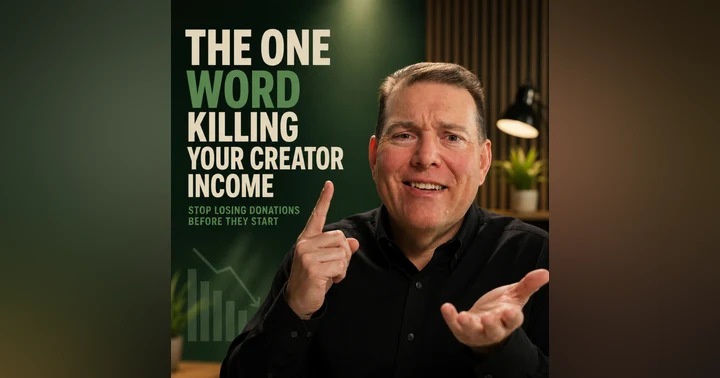
The One Word Killing Your Creator Income
Key Takeaways
- Using the word 'donate' on your website or show notes can mistakenly position your creator business as a charity, limiting your earning potential and damaging your killer creator income.
- Money received from your audience is considered taxable business income by the IRS and goes on your Schedule C, meaning donations do not provide a tax-exempt status unless you are an official 501(c)(3) organization.
- High-earning supporters may hesitate or stop contributing entirely when they realize payments made directly to an individual creator are not tax-deductible despite the use of charitable language.
- Platforms like Patreon, Twitch, and YouTube intentionally avoid the word 'donate,' using terms like 'membership,' 'subs,' or 'Super Thanks' to frame financial support as an exchange of value.
- Replacing the word 'donate' with terms like 'give back,' 'support the show,' or 'become a member' helps shift the dynamic toward an honest, value-for-value business relationship.
The One Word Killing Your Creator Income explores one sneaky little word that could be draining your cash flow without you even realizing it: “donate.” In this episode, I break down why using that word on your website may be doing more harm than good. It’s not your pricing or your upload schedule—it’s the way you position the value of what you create and the way you ask your audience to support it.
I also explore how the word “donate” can affect the way your audience views your business, create potential confusion around support, and even make some of your biggest supporters hesitate. Instead of building a business around asking people to give because they feel generous, we can create opportunities for them to become part of something valuable through memberships, communities, and other offers that create a clear exchange of value.
Check out the full podcast episode here
If you’ve been asking for support but struggling to turn your audience into consistent revenue, this episode will challenge you to rethink the language you use. Small changes in how we position our work can change how people respond to it. We don’t have to beg for pennies—we can build real relationships with our audience and create a business model that gives them a reason to invest in what we’re building.
Takeaways:
- The word “donate” may be costing you money and limiting how your audience views your business.
- Using “donate” can position you as a charity rather than a business built around providing value.
- Your supporters may not realize that payments to you personally are not automatically tax-deductible, which can create confusion and cause potential supporters to hesitate.
- Replacing “donate” with language like “support the show” can help shift the focus toward the value your audience receives.
- Simply calling a payment a donation does not automatically make it tax-deductible, and money you receive may still be taxable income.
- Building a sustainable creator business means focusing on clear value exchanges rather than relying on charity-based language.
Links referenced in this episode:
Companies mentioned in this episode:
- Patreon
- Twitch
- YouTube
- PayPal
- IRS
- Georgia
- California
- Adam Curry
- John Dvorak
- Podcasting Business School
- Jay Clouse
- Colin and Samir
Ready to take your content to the next level?
Join my Creator’s Inner Circle and get access to weekly Action Sheets, coaching sessions, and early episode releases — everything you need to grow your creator business with clarity and confidence.
Sign up at contentcreatorsaccountant.com/join
Frequently Asked Questions
Is money received from a podcast or creator donation tax-deductible for my audience?
No. Contributions made directly to individual creators or for-profit businesses are generally not tax-deductible for your supporters unless you are a registered 501(c)(3) charitable organization.
Why should I stop using the word 'donate' to build killer creator income?
Using charity-based language puts a psychological ceiling on what you can charge, misleads supporters regarding tax deductions, and can entangle your for-profit business in complex state charitable solicitation regulations.
What words should I use instead of 'donate' on my creator website?
You can replace 'donate' with action-oriented and value-based phrasing such as 'give back,' 'support the show,' 'become a member,' or 'join the community.'
Are platform tips and fan funding considered business income?
Yes. Whether collected via tip jars, platforms, or direct payments, money received from your audience for your content is treated as taxable business income by the IRS.
There's one word on your website right now that is costing you money. And guess what? It's not your pricing, it's not your thumbnail, and it's not even your upload schedule. It's just a single word, just six letters.And you put it there. You put it there yourself because somebody told you it was the polite way to ask. The word we're going to talk about today is donate.And today I'm going to show you exactly what the word is, which is what it's doing to your tax bill, what it's doing to your supporters, and what it's doing to your compliance exposure. And listen to this, the business part of this. And it's put as a ceiling on everything you will ever charge.I got this question from a good friend of mine, and that's what I'm answering on today's show. Hello there. I'm Ralph Estep Jr. I'm a licensed accountant. I've been in this gig for 30 years. I'm a business coach and a. I'm.And I'm known as the content creator's accountant. One of the things I do all day long is I look at creator books. All day I look at real books, I look at shows with real audiences.And unfortunately, many of those have almost no revenue. And the leak that I found is in the language before, it's in the numbers. It's all about how you ask for money, determining how much shows up.So today I want to talk about four reasons. Four reasons that I don't recommend that you use the word donate. The first reason is the tax reason. And that one surprises a.And then we're going to talk about the business reason, because that's where the money is. And then I'm going to show you the exact words to use instead of donate, including a friend that gave me the best landing I have ever heard.And then we're going to wrap it up with some action steps that you can finish before you go to bed tonight. So let's get right to it. Is that word on my website right now? See, I want you to hear the big idea before I even defend it.This is the big hairy thing. You're not a cause, you're just not. You're a business that happens to publish.And the problem with using the word donate is people think that means charity. And charity trains your audience and it trains you to believe that you're not actually in it for business. So let's get right to the first thing.The first thing is the word saves you Nothing intact. I've heard so many creators say this. Well, it's a donation, so it's different. But it's not different. Money coming in because people like your show.Guess what? That's income. It's not a gift. I'm going to go right to the IRS code. There's an IRS code section 102 that talks about gift exclusion.And this actually made its way all the way up to the US Supreme Court in a case that's called Commissioner. That's the IRS commissioner versus Duberstein. And what the court found is two detached and disinterested generosity.But then the court refused to make a formula because they just said it's a question of fact. And the judges said, this is the whole picture. So now I want you to judge your whole picture.Let's say you're just had somebody listen to you for 40 minutes. If somebody listened to you for 40 minutes, I don't think they're detached.I think they're pretty much attached to you and they want to keep you going. They want you to be moving forward with your content. That's not disinterested.So you're not detached and you're not disinterested because so many people get something back, whether that's an alert or a shout out on your show or an emote, maybe send out a badge, maybe you give early access. You know, the IRS also looked at crowdfunding. That's a big popular term right now.But it's not necessarily a result of detached and disinterested generosity. And therefore, these are not gifts. It's taxable income. And guess what taxable income is? It's business income.It lands on the Schedule C, which means you're going to pay federal, state, and this big ugly one, self employment tax on top of ordinary income tax. And if you live in a state with state income tax, you're going to pay that too. So if you use the word donate, you're not getting anywhere.And then somebody said to me, well, Ralph, what if it's a hobby? Guess what? If it's a hobby, it's still taxable. It's just other income. There's just no deductions to offset it. And here's the interesting part.So if you get twitch tips, if you get coffees, if you get PayPal donations, the Venmo after episode 12, it's the same treatment, all of it, because you're taking on an awkwardness of that word and getting exactly zero tax benefit in return. So first thing, don't Use the word if you think there's a benefit for taxes, because I'm a tax expert, there isn't. Here's the second thing.And this is the one that sneaks up on you and surprises you. Your supporters can't deduct it. And one day somebody like me, an accountant, is going to tell them that. And this is the quiet one.And this is the one that costs you your best customers. And most of the time you never find out because they just disappear. Because if you're like me, you say the word donate.What's the first thing that comes to mind? The first thing that comes to mind is a person hears charitable, oh, this must be a charity. And here's the problem with that. And it's sinister.That high earning slice of your customers, those people who could support you and support you at scale, they hear that word donate and they say, oh, great, I can write this off. But there is no write off. Let's get back into the IRS publication. It's Publication 526 and it's very crystal clear.It says you can't deduct contributions to specific individuals, even not through a qualified organization, if it's earmarked for one person. Unless. Now, this is the thing. I'm going to take a little caveat here. You can use the word donate or contribution if you're what's called a 501C3.And you might be saying, Ralph, what's a 501C3? That is a specific determination that's given by the Internal Revenue Service. So picture this, it's march.That big supporter goes into their accountant, they go to get their taxes done. And this accountant's going through the shoebox and they hit that receipt with your name, name on it.And the first thing they say is, wait a minute, this isn't a charity. You can't take this. And they call their client, say, hey, wait a second, I saw you put in this for such and such as podcast. You can't deduct that.And here's the problem. Nobody's going to call you, nobody's going to accuse you of anything. It's worse than that.They just quietly stop giving and they quietly stop showing up for your show. There's no dashboard that shows it. That Churn just shows up in the absence of them being on your show anymore. And here's the sinister part.You didn't lie to anybody, but you used a word that made a promise that your business cannot keep. And the person holding that bag is your best supporter. Now here's the other problem. It's the third thing I want to talk about charity language.If you use the word donate, it walks you towards a regulated category for absolutely no value. This is where you got to be careful here. People get this wrong in both directions. Hear me this.Roughly 40 states in the US require registration to solicit charitable contributions. And that counts depends on who's watching. But here's the thing. Those laws apply to charitable purposes.I've already said at the beginning, you're not a charity. You're collecting business income. So you're not covered by these things and know a donate button.And this is one of the interesting things is I was preparing for today's show. There are clowns out there on the Internet that tell you they can register you so that you can use that word donate.But listen, all they're doing is selling you a product and that product doesn't work because of the intention. Here's what should really bother you. What actually flips that switch. I want to talk about two particular states. The state of Georgia codified this.Georgia's Charitable Solicitations Act.Quote, it says this, it says quote, and this is a quote, it says the request or acceptance directly or indirectly of money, credit, property, financial assistance or any other thing of value to be used for any charitable purpose. Well, I don't know about you, but with my content, I'm not using this for charitable purposes. The charity is me.And it defines what they call a covered person to include any individual. But let's go to California. California regulates everything. California in code section 1751 0.2.Not that you have to go look that up, but California Business and Professions code.And this is another quote, it says any statement is made to the effect that the gift or any part thereof will go to or be used for any charitable purpose or organization. They're very clear about that. The trigger is not what you've incorporated as. It's the purpose of what the words describe.And if you hear the word donate, I don't know about you. If we're being honest, I think charity, then separately misrepresentation. It doesn't require you to be a charity at all. Let's go back to California.California Government Code, Section 1259 9.6. And this is a quote. It says a representation may be accomplished by words or conduct or here's the worst part.Or failure to disclose a material fact so the exposure isn't you fail to register.It's borrowing charitable vocabulary for a for profit media you have a business, you collect money under it and you let people believe somehow something's untrue about deductibility. And I'm gonna tell you right now, that's a fact pattern. I don't want my clients standing anywhere near because here's the.In the end, it doesn't even buy you anything. And here's how I can prove that. Look at the platforms. Let's talk about the individual platforms that are out there. Let's start with Patreon.Patreon has spent years, I'm talking about years, training creators to say membership. They don't say donation. The word donation isn't even in their pricing documents. They say membership Twitch. Twitch owned products are bits and subs.Let's look at YouTube, the biggest player they have. Super thanks. It doesn't say super donation, it says Super Thanks. And PayPal. Now, here's the thing about PayPal.PayPal's a little bit off the rails on this one.They're going, they'll process money you call a donation, but it's not really a donation because they don't even give you a discounted charity rate until you send them that determination letter I talked about earlier that says, yes, I am a 501C3. Because see, PayPal understands the legal weight that that word carries. And if you don't have the determination letter, it carries none.Look at the big legal departments. These big legal departments have every incentive to use whatever word would convert best for them.And everyone landed somewhere other than the word donate. And hear me on this, this isn't an accident. Now, I'm going to be fair here.There's plenty of streamers that root third party tips, what they call third party tip jars that still say donate right button. Now, that's the creator's word choice, but that's not the platforms, which means it's yours to change. And I want to be very clear.Your particular situation depends on your state. I'm just giving general education here. I'm not giving specific advice for your specific situation.The states have different solicitations and you need to know what that thing does. But the thing that pulls you towards charitable solicitation law is not what you are, it's what you said. And that's the thing we need to remember.But here's the business side of this. This is thing nobody talks about. It caps your ceiling and it wrecks your books. This is the part that so many people miss.And this is the business half, because this is where the real money is. This show is all about making real money with your content. If you use the word donate, what does it tell your audience?It tells your audience that this show has no price, just no price. And once you've said it out loud, every conversation after that starts this uphill climb. If you say at that point, hey, donate.And then you say there's a $29 membership or $199 course or let's say you're trying to sell, sell a $2,500 consulting engagement, all of that just got harder because you position yourself as a thing people see as being help instead of a thing that people buy. Because in all of our minds, charity money behaves differently than customer money. If you think about it, and I really believe this donation.If you use the word donation, it's a one time emotional act, it's an act of gratefulness. But it's done and once and done. And there's no reason to come back. But the word membership. Membership to me is a relationship. It has a renewal date.One has a lifetime value. That membership has a lifetime value. That donation, hey, that's nice on a Tuesday. But then it hits your books.I'm going to get real accounting lingo here. A donation isn't a category. There's no such thing as a donation for a for profit saying. So what happens to it?It goes in the junk drawer and in six months later you're trying to figure out what thing worked. And you have no idea. You have no idea which episodes drove revenue. You have any idea about revenue per listener.And you can't tell me a line that describes a feeling instead of a transaction because you can't optimize what you refuse to categorize. But now I want to give you a solution. I'm going to give you the fix, the swap. Now you don't need a lawyer, you don't need some fancy rebuild.Don't go spend thousands of dollars online. It's really simple. I'm going to encourage you to do one thing and most of us know how to do this. Find and replace.I want you to go to your website and find the word donate and I want you to change it. Here's something. I'm going to give you some great ideas.So instead of using the word donate, how about use the word give back or support the show or I like this one even better. How about become a member? Now go look for the word donation. Same thing. Instead of using the word donation, use membership. Use tip. Hey, use tip.Because there's a great tax rate about that And I'll talk about that in a future show. Or say contribution to the show. Or even better, just name the product. We talk about having a product, something they can buy. Name that.If you've got a button right now that says donate button, change it. How about the word join? How about the word support? I like this word even better. How about buy or become a member?But you got to change the way you see your people as well. If you're using the word donors, I'm going to encourage you to change that to members or supporters or patrons or even subscribers.Now, when you're recording, here's something else you got to change. I hear this all the time when I listen to people. People say things like, consider donating. Donating. What? Here's what you get.Here's a better thing to say. Say hiss. Say, here's what you get when you join. I hear this one all the time. Help me keep the lights on. That one drives me crazy.Rather than that, say this, here's what your support builds Next. Those three lines, you can steal all those today. I'm going to give you three more here. Membership. I love this word membership.And then what you can say is this. You can say, if this show saves you time. Every week membership is just $9 a month.You get the ad free feed, you get the weekly action sheet, and you get the monthly Q and A. You understand the difference there? Membership. How about this one tip? If an episode helped you, there's a tip link in the show notes.It's not a donation and it's not tax deductible. It's just a thank you. And I read every single one of those. Now I'll put my accounting hat back on again. How about using the word product?And you can say something like this. The template I described today is $15, takes you 10 minutes and saves you four hours that I spent building it. What's the thing all of these share.Everyone names an exchange value for value. Everyone gives the listener something to receive, not just some feeling. Feeling isn't going to put money in your bank account.You got to give them something. So name the exchange. And then people just stop deciding whether you deserve it and start deciding whether they want it.Now, I told you, I sent this to a friend. He was helping me build this episode. And he said, ralph, I got a great idea. And he uses the word give back.And I think that might be the best of everything on that list. And like I said, this didn't come from me. A friend read a draft that I. And he pushed back and he said, ralph, use the word give back. And I love this.And I'm gonna tell you why I like it. He's right about three things. Number one, it describes the transaction honestly.You made something, that person received it, and now they return what was worth to them. That's the whole value for value model. Adam Curry and the late John Dvorak have this show called no Agenda. They've been doing this since 2007.And their show, the audience decides what it's worth and they settle up. So that's the one thing that I love. Here's the second reason it runs the right direction. If you say give to the podcast, what are you saying to them?That just points in one direction with money towards a project that needs it. But if you say give back, give back, assume something. They've already arrived. The listener is answering you.They're not starting reciprocity without the weight of a bill. And number three, and here's the thing that I think is beautiful about this. It's not locked to cash.If you use the word donate, it suggests money or goods. And a tip. Hey, a tip means money. Only contribute is three syllables of nothing. Give back holds anything.Which is why the whole value to value thing even works. Think about this.
Speaker BValue to value.
Speaker AYou can give your time, you can give your talent, and you can give your treasure that attention is worth something. Your skills are worth something. Money is the third on that list, not first. The people can write you a review.If you can't send $15, they can send you a review. They can make an intro to somebody. Maybe they can offer an hour of editing skills, or they can share that reaches somebody that you can't.Now, I want to put my accountant hat back on for two footnotes. Here's the first one. None of this changes. Step one, don't use the word donate. If you hear nothing else. I say today, and I've been.I've been on a lot of shows, I've used this same thing. Don't use the word donate. I love the word value for value because it's an explicit statement that the money is payment for something received.And that's what it is. That's the opposite of detached and disinterested generosity. That's what the IRS said. If it's detached and disinterested, that's a gift.This is not that. And it more honestly describes the exchange. It's income, and income's fine. It's always been income, and you've stopped pretending otherwise.But here's my second footnote. Give back fixes charity, not pricing. And this is the thing I want to spend just a minute on. It still leaves the amount to the listener.And here's what I found an audience given. If you don't give them a number, it's always going to guess low.So one of the things that I encourage you to do is open the door and then add a priced offer behind it. So here's. Let me give you an example. Give back whatever or however you want.And if you want my ad, free feed and a weekly action sheet that's $9 a month. Do you see the difference?With that, you're telling them, here's the minimum and that's one invitation for everybody and one number for the people ready to pay. Now, I want to give you one last honest thing. Even the originals haven't escaped the old world.When I did some Wikipedia, and I don't know how valuable Wikipedia is, but it still describes the no agenda as subsisting. And this is what it uses entirely on donations.The problem is it's a sticky habit, but that's one more reason to choose it on purpose, to not use that word. Give back is the open door. A number is the doorway. And you need both of this. Now, I'm not alone in any of this.Let's go back to who was saying it first. Adam Curry and the late John Dvorak. No agenda. They have had no advertiser since 2007.That show has existed entirely on value for value, not just cash, time, talent and treasure. And they built the alternative to that donate button before most of us even noticed we needed one. Adam Schwebel from Podcasting Business school.He said 600 plus episodes on one question. And his question is simple. How do you actually monetize an audience? You notice what he says there? Monetize an audience?Not how do you ask nicely for help. That's not what he's talking about here. Jay Clouse, creator. Science has a whole body of work. It's on products and memberships.He even teaches a course called Build a Beloved Membership. He doesn't say build a beloved donation page. And finally, there's Colon and Samir, the Colin Samir Show.They cover the creator economy better than anybody and they keep landing in the same place. And this is what they say. The creators who last built a business, not a tip jar. Are you building a tip jar or are you building a business?These are different people and they reach the same conclusion every time. The people who study this for a living all end up in the same place.Those creators who last are the ones who sold something, not the ones that asked for help. Now right now, you might be saying to yourself, Ralph, everything you've talked about, this is my show.I'm looking at my website, I'm doing all of these things. That's exactly what my page says right now. Well, that's why I offer a monetization audit.I'll look at your show, I look at your audience, I'll look at your current setup and I'm going to show you where the money is actually hiding. And if you want to do that, it's super simple to sign up.Just go to https://contentcreatorsaccountant.com/audit we'll put it like in the show notes, a link to it. But go to https://contentcreatorsaccountant.com/audit so here's three things that you can finish all of them.Tonight I promised you to give you some action items and here they are. Number one thing, when you leave this show, open your website and search the page for the word donate.If you find the word donate, replace every one of those. And once you do your website, look at your link trees, look at your show notes templates, any pin posts you have.And here's one a lot of people don't think about. Look at your channel descriptions, get rid of that word and pick one of the other ones.And then secondly, equally part thing, write your two part ask, do the open door and the number. Like I said, say something like this.Give back however you want plus one priced offer, just one sentence each and put it in this week's mid roll and see what changes.Now the account side of me says do one more thing and that's open your bookkeeping and find every transaction sitting in a donation category and categorize it into the offer it actually came from. Was that from membership? Was it a tip? Hey, tips are a big deal because the IRS will allow you to deduct tips. Or was it product sales?Because if you can't tell which is which, that by itself is finding a flaw in your system. Now I want to leave you with a reframe because the reframe is the whole episode in one word. You're not asking people to fund your existence.You're offering a way to buy more of something they already told you that they wanted. They told you they wanted it by showing up. They told you they wanted it by listening this long, by hitting that play again next week.That's not a charity, that's demand. And demand deserves a price. Not some plea for help. Nobody has ever built a durable creator business on the word donate. It doesn't exist.But plenty have built one on give back and plenty more on the word join. So if you're looking for help right now, I want to give you a full walkthrough of your own show.You can get that by going to https://contentcreatorsaccountant.com/audit. Again, that's content https://contentcreatorsaccountant.com/audit because this is what I do.I'm Ralph Estep Jr. And I am the Content Creators Accountant, and I'll see you in the next episode.