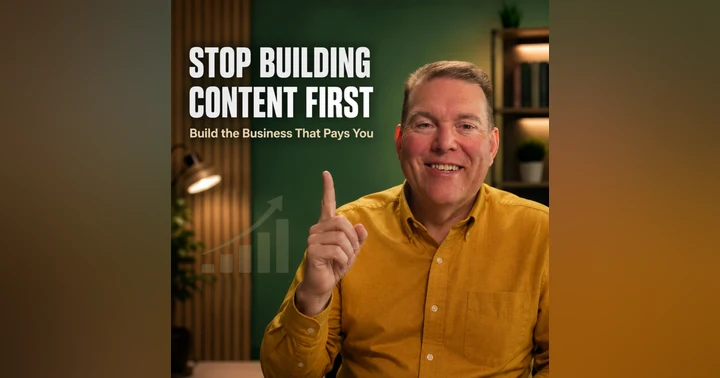
Stop Building Content First – Build the Business That Pays You

Key Takeaways
- Many content creators suffer from a business problem rather than a content problem, often producing endless material without a clear plan to build the business first.
- Attention and follower counts do not automatically translate into revenue, as less than 4 percent of creators earn a full-time, sustainable living.
- Content should function as a marketing tool that drives people toward clear offers and revenue opportunities rather than serving as the business itself.
- A proper creator business framework prioritizes five key elements in order: audience, problem, offer, system, and content last.
- Self-employed creators must separate personal and business bank accounts, track revenue streams, and set aside money for self-employment and estimated taxes from day one.
Stop Building Content First – Build the Business That Pays You challenges the way many creators approach their business. If you’re spending countless hours creating posts, chasing trends, and upgrading your equipment without a clear plan for generating revenue, you may not have a content problem—you may have a business problem. I break down why creating more content isn’t always the answer and why your content needs to work for your business rather than becoming the business itself.
Check out the full podcast episode here
I also take a closer look at the creator economy and the challenges creators face when trying to turn attention into sustainable income. With millions of creators competing for visibility, simply having an audience doesn’t guarantee profitability. I explain why content should serve as a marketing tool that drives people toward clear offers, revenue opportunities, and a business model designed to actually pay you.
If you’re tired of putting in more work without seeing meaningful financial results, I want you to rethink what you’re building. Instead of endlessly producing content and hoping it eventually pays off, build the business first, then use your content to support it. Your goal shouldn’t be to become better at creating for the sake of creating—it should be to build a business that turns your expertise, audience, and content into sustainable income.
Takeaways:
- Creating content without a clear business model can keep you busy without creating meaningful income.
- Content without a business strategy can lead to wasted time, effort, and resources.
- Attention and popularity do not automatically translate into revenue; you need a clear plan to monetize your audience.
- Breaking the “broke creator” cycle requires thinking and operating like a business owner, not just a content creator.
- Your content should function as a marketing tool for your business, not serve as the business itself.
- Clearly define who you serve and the problems you solve so your content can attract the right audience and support your revenue goals.
Links referenced in this episode:
Companies mentioned in this episode:
- Goldman Sachs
- Linktree
- Pat Flynn
- Smart Passive Income Podcast
- Adam Schwebel
- Podcasting Business School
- Jay Clouse
- Creator Science
Ready to take your content to the next level?
Join my Creator’s Inner Circle and get access to weekly Action Sheets, coaching sessions, and early episode releases — everything you need to grow your creator business with clarity and confidence.
Sign up at contentcreatorsaccountant.com/join
Frequently Asked Questions
Why do most content creators stay broke despite having high engagement?
Many creators focus entirely on posting content and chasing algorithms without building a solid business model, a clear offer, or a proper financial tracking system behind the scenes.
What is the correct order of the five-part creator business framework?
The proper framework requires you to first define your audience, identify the problem you solve, create a clear offer, establish your financial systems, and only then let content serve the business last.
How should content be utilized in a profitable creator business?
Content should act as a marketing tool designed to attract the right people, build trust, and direct them toward your core business offers and monetization streams.
What tax obligations do content creators need to prepare for?
Because creators are self-employed, they must file annual returns, make estimated quarterly tax payments, and cover a 15.2 percent self-employment tax in addition to federal, state, and local income taxes.
Speaker A
Let me say something that might sting a little bit. If you're a content creator and you're building content before you build a business, there's a good chance you're going to stay broke.Now, I know that sounds harsh, but I'd rather tell you the truth than watch three years go by. Three years of where you're posting, you're chasing trends, you're buying gear, you're paying for editors, you're taking courses.And that bank account of yours still doesn't match the effort. I want to start off with something bold. Most creators don't have a content problem. They have a business problem.So on today's show, I want to talk about how your content should serve your business.So right now, if you're tired of creating, if you're tired of posting and editing and uploading and still wondering where the money is, this episode today is for you. Foreign. Hello. I'm Ralph Estep Jr. I'm the Content Creators Accountant. And so you know a little bit about me.I've spent the last 30 years helping business people make money. That's what I do.And I've helped creators, I've helped coaches, I've helped podcasters, YouTubers, influencers, online entrepreneurs, all of those people. I've helped them stop guessing with money and build real businesses. Not from hype, not from complicated tax talk.You're not going to get that here, and definitely not from shame. Every day. My goal is to help you keep more, plan for your taxes and protect your income.And in the end, I want to treat your creativity like a business. Because guess what? It's already a business. And today's big mistake is this.Most content creators start with the content, but they should have started with the business. Now I want to start off with a lie. Like, wait a minute, Ralph, you just starting the episode. You want to lie to me? No.I'm going to tell you about a lie that creators keep hearing. I hear it constantly. You've probably heard it yourself. You've heard it. People say to you all the time, we'll just post something.As long as you're out there, you're being consistent. Find your niche. Grow your audience. Beat that algorithm, Ralph, you got to post 3 times a day or more. Use this hook. Try this trend.Hey, play this sound. People are going do it. Now, I'm not telling you that none of those things matter. Some of those things have a place, but it's incomplete.Because here's the truth. You can post every single day. You can post ten times a day. And still have no real money. You can grow an audience.You can have hundreds of thousands of people that are ingesting your content, still have no business. And yes, you can go viral and still don't have a way to pay your taxes. Because here's the thing I've learned over 30 years.Attention is not the same as income. Those followers are not the same as profit, and content is not the same as business.Now, a lot of people say to me, but wait a minute, Ralph, you're missing out. This big economy of content creation means I'm going to get paid. That's lie number two. The big economy doesn't mean you're going to get paid.Now, Goldman Sachs, this is what it says. The creator economy right now is estimated to be $250 billion. That's a lot of money. And in fact, they say by 2027, it's going to grow to 480 billion.And it sounds like a lot of money until you hear this one. There's 50 million global creators. So 480 billion divided by 50 million. Here's the thing. This is the truth. I'm not gonna lie to you.I'm gonna tell you. I'm not gonna sugarcoat it. 4% Of content creators are earning more than a hundred thousand dollars a year. Just 4%.Yes, it's a huge industry, but very few people build something that pays them. You can have an economy that's booming, but your account is still struggling.Just because the creator economy is growing doesn't mean your creator business is growing. Because here's the big problem that I see with creators almost every day. So many creators are busy.They're busy doing the things, but they're not busy building a business. Just think about it yourself. If you're a creator that gets traction. Let's say you released a video or a short that just took off.You got a brand deal. That's fantastic. You get a little money in. Maybe YouTube pays you, or you get some affiliate income.You got some stripe transactions, maybe You've got some PayPal. Don't use the word donations. You got some PayPal support or Patreon memberships. You see that money come trickling in, you're like, oh, this is great.I'm making it. So what do you do? Like most of us, you go and you upgrade your equipment, you buy a new camera, you get better software, maybe you hire some editors.And then what happens? You spend it all and you forget taxes, and you mix your business and your personal money because you need it.And then what happens is April shows up and you got to come see somebody like me. And I'm saying to you, hey, guess what, you owe tax. You're like wait, wait a minute, I don't have that money.Or maybe you've got that wonderful sponsor and that sponsor doesn't renew anymore. Or how about this one? I've seen this one destroy youtubers. The algorithm changes overnight and what worked yesterday doesn't work anymore.And you say to yourself, where did all the money go? That right there is what I call the creator broke cycle.And here's the thing, if you want to break out of that cycle, you don't break out of it by making more content. That is never going to solve the problem. You can make a zillion things in content. You're never going to break out of that broke cycle.You break it by building a better business. And here's the numbers that prove what I'm talking about. This is the truth. I said a couple lies and I'm going to talk about some truth.There's a link tree creator report and I'm giving you some numbers that are going to shock you again. We'll link to it in the show notes. But Linktree Creator Report. 59% Of beginning creators hadn't monetized yet.So almost 60% of new creators aren't monetizing in anything. 35% Have monetized but below a livable income. So what's the point? Full time creators, these are people that doing this full time.Only 12% made more than $50,000 in a year. But here's the scare statistic of them all. 46% Full time creators made less than a thousand dollars in annual revenue.They're doing full time work, they're putting in the effort, they're staying busy. But still no business that pays. I'm talking to you right now. This is not a talent problem. It's a structure problem. And here's the issue.So many creators think their content is the business. Your content is not the business. I'm going to tell you right now, your content is not the business. Content is marketing. It's not the business.The business. And if you've listened to my show, I'm going to encourage you go back and listen to the other episodes. I've tied this all together every week.The business that you're in is solving a problem. It's what you sell. That's how the money comes in. It's how you deliver value. It's how you build profit.Of course your content supports that it points people to it, it moves people to it. But if you've got no business behind it, and this is the big problem, if there's no business behind it, that content is just busy activity.And I get it, because activity feels productive. You're like, well, wait a minute, Ralph, I have 300 episodes. I've got this many YouTube followers. I got this, I got that.But none of those things create income. You got to have a business model. You got to have a structure. You got to have numbers. Not some feel good vibes.Again, your content is not the business. Your content is the marketing. Which leads you to a realization that a lot of creators have finally figured out.You got to stop asking what I should post. That's the very wrong question. If you're thinking right now, I'm watching, Ralph, but let me think about what I can post.What I should post today is the wrong question to ask. Before you do anything else today, you've got to ask yourself a much different question. What business am I building? That's the question.Not what content. What business am I building? I'm going to give you some examples. Coaching business.If you're building a coaching business, your content needs to build trust. They need to look at you like you're looking at me and say, oh, this guy makes sense. He's got credentials. He's telling me something of value.You got to show them the problem and offer a solution so that you can coach them to change their dynamic. Or maybe it's a digital product. Then your content educates them. It leads them to that product that you're selling. Or maybe it's services.If it's services and your content shows expertise, they talk about why to hire you. Like when I do my content monetization audits, it's all about a service.My content is showing you that I know what I'm talking about and why you should hire me. Maybe it's your business's membership. Then the content's got to show why they need ongoing support, why they need to be a member of your community.Maybe it's something simple as affiliate income. Then the content helps them buy smarter. And this is a trap. You got to be really careful with affiliate income.If you're going to go after affiliate income, make sure it's something that your audience needs, something you've tested and something you support. Because a lot of people go chasing after affiliate income, but it doesn't fit their audience. Now maybe your business is sponsorship and that's fine.You can go out there and get Sponsors, then your content serves an audience that sponsors one. Do you understand the difference there? Once you look at those things, once you understand the business behind it, then your content has a job.Your content's got to have a job. It can't be random, it can't be trend chasing. Yeah, you can get viral numbers, you can get subscribers and followers, but guess what?You're going to be broke. You are going to be broke. It's all about intentionality. Intentional content supports a business. Random content supports burnout.And I've seen so many creators get burned out because they were just random. And now you're probably saying, okay, Ralph, I get it, I agree with you. How do I fix this? I'm going to give you the key.There's three questions that every creator has to answer. Here's question number one, and we'll put these in the show notes because these are the things you've got to do. Question number one, who do I serve?You got to start there. If you don't know who you serve. When I work with you as a content audit, the first thing I want to ask you is who do you serve?And if you say to me, everybody, I'm going to tell you that everybody is not a market, everybody is not a customer, everybody is not a strategy. You got to pick the actual person that you help. You got to have an idea in your mind. What does this person look like? What are their needs?What are their wants? What are their desires? What are they having? A pain point that you're going to solve.You can build broad content and you know what you're going to have? You're going to have attention without conversion. What does that mean? It means you're going to stay broke.Here's the second question, equally important, what problem do I solve? If you can't answer, what problem do I solve? Then you don't have a business model. Because here's the truth.People are never going to pay you for content. It isn't going to happen. But they pay you to solve a problem, and they will pay you handsomely to solve a problem.If you can save them time, if you can help them make money, if you can help them avoid mistakes, if you can help them get clarity and build something, they will pay you for that. And here's question number three. And so many content creators never get to this question. This is the question that content creators avoid.And I've heard it say. They say to me, Ralph, well, I'm just building my business. What do I sell? Because if you say to me, I'm just building my business.I'm going to say to you, very simple. What are you building it for? Is it consulting? Is it coaching? Is it courses? Is it templates? Is it memberships? Is it products?Hey, these are all good things. It could be speaking, it could be sponsorships. And here's the most beautiful part of these three questions.It doesn't have to be perfect, you just have to have a direction. If you don't know what you sell, then you don't know what your audience wants to buy. So how do you get started?I'm going to tell you right now how to create the revenue model before the content calendar is even created. I'm not telling you to don't have a content creator calendar. It's helpful. I think it's important.But the revenue model is so much more valuable to do. You got to map out how the business works before you post anything else. If you've already got a content calendar, I'm going meditator.Call a timeout, call an audible and build a business plan. You've got to answer the question, how does money come in? How am I going to get the money? How often is it going to come in? What's my offer?What's the price? What's it going to cost me to deliver it? What's the margin I'm making on that? How many sales do I have a month? What do I need to get?What are my expenses? And don't forget about taxes. Taxes need to set aside, too. And then the biggest one of them all, how much can I safely pay myself?If you only ask content questions, you're going to build a content machine. But a content machine is going to keep you broke and you're never going to have a money machine.Now, maybe right now you're making a little bit of money from content, but you're just not sure where it's going. You're worried about taxes, you're worried about mixing personal and business money.It's a mess you're creating every week, but you're unsure if it's a real business. That right there is exactly what I help creators fix. I'm going to encourage you to go to content creatorsaccountant.com helpme. Yes, help me.That's what I want to do. Book a call with me. We'll look at your content business.We'll look at your money structure, we'll talk about tax planning and we'll talk about what needs to change. Again, that's content creators accountant.com helpme. Alright now let's get back to the episode. It's time for me to put on my accountant hat.If you've got money coming in from content, hear me on this, you're already in business. And if you're already in business, you gotta deal. If you're in the United States, at least you gotta deal with something called the irs.That's the Internal Revenue Service. You're self employed because you've got money coming in, which means you have to file an annual tax return. And guess what?If you've got to file a tax return, you also have to pay estimated taxes. And here's the part nobody tells you about. You got to pay self employment tax plus regular income tax.And here's the thing, self employment taxes, 15.2%. That's before federal tax, state tax or local income tax depend upon where you live.That's before you put money into retirement, before you pay for your health insurance, and before you reinvest. When a creator says to me, Ralph, I made $10,000 this month, my first question is this, did you really or did it just pass through your account?Which leads me to this, another truth. We talked about lies at the beginning. Now we're getting into the truths. Revenue is not profit. I hear this all the time, it drives me crazy.If you have a $10,000 a month, which is great, that's very admirable, but break down that $10,000 month you got. 10,000 Came in the door, great, you paid 2,000 to contractors, you have $500 of software and subscriptions in that bundle.Maybe you spend a thousand dollars on ads or equipment or production costs.And don't forget these things, those payment production fees, those payment processing fees, the platform fees, the editing, the bookkeeping, the money is set aside for taxes, do that at the beginning. And then those personal bills, it just kind of came out of the business account, it wasn't all yours. Yeah, you got $10,000 coming in the door.But some of it went for the business, some of them went for taxes. Some of it are going to that slow month, that reserve, that growth. Maybe you got some profit, some owner pay.But if you don't have a system, and that's what I'm really talking about today, is building a system. If you don't have a system, it all blends together. And I've had so many creators say to me, well Ralph, man, I got money in my bank.Your bank balance is not profit. Some of that money spoken for, that stripe deposit you got last week, that's not your paycheck. That AdSense payout is not a business model.And hear me on this one, that follower count, that's not a financial plan. Revenue is not profit. You need numbers, not just vibes. So let's talk about what a real creator business needs.I'm going to give you a list of things that you've absolutely got to do if you want to be successful as a business person in content creation. This is the list that nobody's telling you about. Number one thing, you've got to have a separate business bank account.If you do nothing else I say today, go out right now online and open a separate business bank account. You got to separate your personal and business expenses. You can't live in the same world in one big old pie of a soup. It isn't going to work.You got to have a bookkeeping system. And I'm not telling you have to have something elaborate. You don't need to go get QuickBooks or Waze or any of those things.You just need a simple system that you are going to use. And then you've got to track your income by revenue stream.You got to know where your income is going because if you don't know where your money's coming in from, you don't know what's working. And then you got to categorize your expenses by category. You got to know what's deductible. You need to know what to set aside for taxes.Yeah, set aside the money when it comes in. I talked about this earlier. You got to know when estimated payments are due because guess what, no one is withholding money from you anymore.You're self employed. You got to deal with the irs. You got to understand estimated taxes. You got to understand self employment taxes.You also have to plan for those slow months because there are going to be months that aren't going to be those $10,000 paydays. You got to understand how much can you actually pay yourself? What is profit? Do I profit first? We'll talk about that in an episode coming up.And you've got to know when an LLC makes sense or when it's time to start talking about an S corporation. Or maybe you're hearing it from all sides and you're like, Ralph, it's not numbing. I just don't know what to do.It's not just about what form do I file. Yeah, you can go out and watch YouTube and TikToks and say, well, what form do I need to file?There's a lot of Clowns out there that could tell you to do that. But that's not the question.The question you need to find, and this is why I'm pitching to you today, you need to understand, how is this business actually built? Now, I'm going to tell you right now. I hear a lot of people talk about the YouTube algorithm.Well, Ralph, I'm making money on YouTube because I'm riding the algorithm kind of like this roller coaster. Problem with a roller coaster, it goes up and down and eventually it comes to a stop. The problem with an algorithm is you can't control it.You have absolutely zero control over it. If that platform change, if you don't go viral anymore, or if that, if that sponsor just doesn't renew, you have no control over it.It's just out there. Good luck. And here's the truth. A lot of people won't tell you this. Most creators are never going to make a money on those platforms.They're never gonna make any sizable money on it. Some will. It's a very small percentage. But let's talk about the things we can control. Here's things we can control right now.You can control your business model. You can control your offer. You can control your pricing. You can control the systems that are built around that. You can control your taxes.You control how the money moves, how your business accounts and the tracking. And you can control whether your content points somewhere. Peace in this financial peace, if you will. Starts with structure, not more views. One thing.Did I mention downloads or watch time? So hear me on this. The algorithm is not a business plan. Let's talk about what that content should serve in the business. Because here's the thing.I want you to land on. Every piece of content that you make from this point forward should do at least one thing, just one of these things.It's got to attract the right person. It's got to build trust. It's got to educate.It's got to answer someone with a buying question, show them the cost of staying stuck, invite the next step, move them towards being a better customer. Stop asking that question. How do I get more followers? How do I go viral? I am so sick and tired of hearing that question.I see it on these Reddit questions all the time. Ralph, how do I go viral with my content? Stop asking that question. Ask this question. Ask this question. Because you can actually control this.How do I serve the right people? Notice what I said? They're the right people and give a clear way to work with me.When content serves the business, you stop chasing Attention and you actually start building income. Now, I mentioned a little while ago the broke creator cycle. I'm going to break it down for you because I got it. I can lay it out in eight things.Here's the broke creator cycle. It starts like this. You create content and you get attention.Hey, somebody looks at it, you get a little money coming in and you spend it because it feels like profit. You forget about the taxes, your income slows down, you go into panic mode. And what do most people do? They make more content and they hope.And here's the problem with that model. That happens at $500 a month. It happens at $5,000 a month. And a lot of these influencers have found it. It works at $50,000 a month.Also, it's never about how much money comes in. It's about, it's about how you manage the money that comes in. You can have as much revenue as you can imagine.And that just makes a broken system more dangerous. Because then you got bigger mistakes, you got bigger payrolls, bigger tax surprises, and yes, bigger pressure.Stop waiting till it's big enough and get serious now, because more revenue is never going to automatically fix a broken system. The business has to come first. Stop building random content, hoping a business appears.Define your business, define your audience, define your problem, define your offer, define your money flow and define your systems. Once you do all those things, then create content that supports all of that. That's how this content becomes an asset.Again, the business comes first, then the content serves the business, not the other way around. If you've got it backwards, which, listen, a lot of you watching now have got it backwards. Here's my five part creator business framework.If you can master these five things, I guarantee you will be profitable with your content. Number one thing, I've said it a couple of times now. Audience, who do you serve? And you got to be super specific.My audience is, here's why I serve them. That's number one. Second thing, the problem. What is the problem that you solve? And they got to see themselves in that problem.Third thing is an offer. And so many creators don't get this part of it. You got to have an offer. What do you sell? I watch a lot of content and not one time can I tell.What do they serve? Who do they sell for? What is their product, what is their membership, what are their services? Do they have a course? Consulting?They don't even mention it. There's no offer. Guess what? It's kind of like going to a store.You get to the Front of the store, you got all this stuff you want to buy, but there's no place to check out because there's nothing to buy. Here's the fourth thing. You gotta have a system. I'm a systems guy.You gotta understand how does the money move, how does it get deposited, how does it get tracked? Don't forget about taxes. How do you pay yourself? And then all the way at the bottom of the list, content. I haven't mentioned content yet.You're like, wait a minute, Ralph. You're talking to content creators. Content is dead last. Content is what you create to support the first four. You got to get this order right.Audience problem, offer system, and then content. Most of the people watching this video right now or listening to my voice put content first. And that's why they continue to struggle.If you put the business first, then let the content do its job. Now, I want to end on an emotional note here, because I want to talk about why this matters emotionally.I'm a guy that's been helping people financially for over 30 years. And here's the thing I found being broke isn't just financial, it's emotional.It is completely exhausting to create every day, be consistent, put out that product, and not know if it's working. It's discouraging as it can be to see people viewing, but there's no revenue coming down the door.I had somebody say to me the other day, they said, Ralph, I see you everywhere. That's great, but if you can't cover your bills, how does that help you? It's super stressful to earn one month and panic the next.It's scary when tax season shows up and you're not ready. Somebody like me calls and says, hey, yo, money. Wait a minute. Where am I getting the money from?Your creativity is a gift, and it shouldn't drain you. That structure that I'm talking about today can give you peace. It's not just about accounting.This is about building something sustainable that you can live in. And I'm not the only one saying this. I'm going to give you some big names right now. Pat Flynn. A lot of people know Pat Flynn.He's got a podcast called the Smart Passive Income Podcast. He built his entire name teaching people to build a real business behind the content, not just an audience.He's got a huge audience, but what did he build? He built a business. Adam Schwebel from Podcasting Business School, he said it himself. He said, a show with no offer is a hobby, not a business.And Jay Clouse Creator Science says creators leave real money on the table with no system to capture it. These are completely different people, but they all come to the same conclusion. The smartest people in this space all say the same thing.Your audience is not the business. The business is what you build behind it. And this is where I come in. Because right now a lot of you are saying, you know what, I need this.But Ralph, I don't even know where to start. And that's exactly what I do. I help creators, just like you, build a business behind their content.We'll look at the money, we'll look at the structure, we'll look at your taxes, and I'll help you build systems. We'll talk about how the money comes in, where it goes, and what to fix. I'm going to help you break through that confusion.Not just another generic course, not just. I'll go post more. Your content is creative, but your money still needs structure.So right now, if you're tired of creating and still feeling broke, if you're tired of inconsistent income, you're tired of being unsure what to set aside for taxes, your business and your personal money is mixed together and money is just disappearing. If you're ready to stop treating it like a hobby, I want to encourage you to get some help.And you can go to content creatorsaccountant.com helpme book a call with me. It's 15 minutes. Won't cost you a dime. We'll look at where you are, we'll look at what's missing.And I help you build the structure that you need so that you can stop guessing, you can stop spinning, and you can stop being in that broke creator cycle again. That's content creatorsaccountant.com helpmes the goal is not to just make content. That's a great thing.But the goal is to build a business where your content helps you make money. Your content is not the business, it's marketing. Those followers are great, but they're not your financial plan.Those views that you create, fantastic, but they're not your profit. That bank balance is not your bookkeeping system, and that algorithm is not your business model. Again, I've probably said it 10 times. Business first.Who do you serve? What do you solve? What do you sell? How does the money move? Tax set aside? And is the content actually building the business?When you get it right, and you can get it right, there's a system here. I will help you build that system. When you get it right, everything changes and you start to build with intention. Hear me on this.You're not just a content creator. You're a business owner. And the sooner you start acting like one, the sooner your content can start working for you instead of wearing you out.So stop building that content first and build the business and then let the content serve it. That's how you break the cycle and stop feeling broke again. One more time. Content creators accountant.com help me book a call.Get your structure right and get your money right. Because I'm Ralph Estep Jr. And I am the Content Creators Accountant. And I'll see you on the next show.