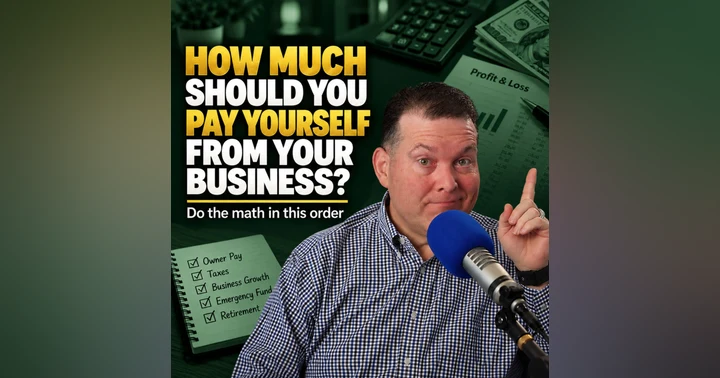
How Much Should You Pay Yourself?

Key Takeaways
- Taking an owner's draw does not lower your business's taxable profit, which is why many creators face massive tax bills despite not overspending.
- The correct order for distributing your business income is tax, debt, reserve, and then yourself.
- Relying on a blanket rule like 'just set aside 25% for taxes' can leave you dangerously short depending on your actual income and profit levels.
- Running a simple four-number financial check each week can help you determine a safe, sustainable monthly owner's pay without risking an IRS surprise.
She pays herself $9,000 a month and thinks she's being conservative. She's $16,500 short at tax time, and she didn't overspend a dime.
I'm Ralph Estep Jr., The Content Creator's Accountant. In this episode, I work through one business and one year of math so you can figure your owner pay in the right order. The order is tax, debt, reserve, and then you.
Year-End Business Review:
contentcreatorsaccountant.com/review
What you'll hear:
- Why an owner draw never lowers your taxable profit
- How a $120,000 profit turns into about $28,500 in federal tax
- Why the same owner can safely take about $6,600 a month instead of $9,000
- Why "just set aside 25%" can be wrong for you
- A four-number check you can run this week
Mentioned in this episode:
Profit First by Michael Michalowicz
Simple Numbers, Straight Talk, Big Profits by Greg Crabtree
This is general information, not advice for your specific return.
Have a question for me? Send it in, and follow the show so you catch next week's episode on S corporations.
Frequently Asked Questions
How much should you pay yourself as a content creator?
You should calculate your owner pay only after accounting for taxes, business debt, and financial reserves, rather than simply taking whatever cash is left over.
Does an owner draw lower your taxable business profit?
No, taking an owner's draw does not lower your taxable profit, meaning you still owe taxes on the net income of the business even if you withdrew the cash.
Why is setting aside 25% for taxes sometimes wrong?
A flat 25% rule often fails to account for self-employment taxes, federal brackets, and state taxes, which can easily exceed 25% for profitable digital entrepreneurs.