How Much Should You Pay Yourself From Your Business? Do the Math in This Order
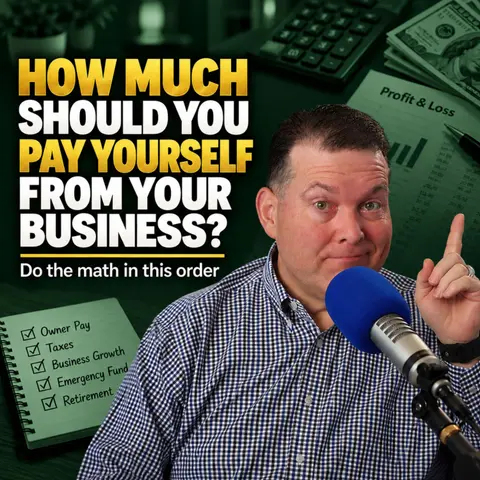
How much should you pay yourself from your business? I've heard that question from owners for 30 years, and almost nobody gets a concrete answer. They get a rule of thumb, or a number that feels safe, and then April 15th shows up and the bill doesn't match the plan. After all that time across the desk, I'm convinced this usually isn't a spending problem. It's an order problem.
A $9,000 a month draw that looks conservative
Picture a commercial cleaning company doing about $650,000 in revenue. The owner is a single filer who set up a single-member LLC, taxed as a sole proprietor. After expenses she has $120,000 in profit. She takes $9,000 a month, which is $108,000 a year, and figures she's playing it safe because $12,000 stays behind in the business. That feels like a cushion. It isn't, and the reason is tax.
Does my owner draw lower my taxes?
No. If you're a sole proprietor or a single-member LLC taxed that way, a draw is not an expense. You're taxed on the full $120,000 whether she takes $108,000, $50,000, or nothing at all. The draw only changes your bank balance. Your profit is what changes your tax bill, and you owe tax on money you already took home.
What the tax bill really looks like
Self-employment tax is 15.3% on 92.35% of your profit. Here that means tax on $110,800, which comes to roughly $17,000. For federal income tax, a single filer gets a $16,100 standard deduction and a 20% qualified business income deduction, which drops her taxable income to about $76,300. The income tax on that is roughly $11,500.
Add the two and you get $28,500, and that's federal only, before any state or local tax. She left $12,000 in the business and owes $28,500. She's $16,500 upside down, and the money has to come from somewhere. Usually that's savings, a line of credit, or a credit card.
What is the right order to pay yourself?
Tax first, debt second, reserve third, and then you get paid. Start with the $120,000 profit and take out the $28,500 in tax, which leaves $91,500. She has no debt payments, so that step costs nothing here. If you carry loans or card balances, they come out next. Then set a reserve for slow months. At $1,000 a month that's $12,000, which leaves $79,500. Divide by 12 and her real pay is about $6,600 a month, not $9,000.
I didn't invent this. Michael Michalowicz built Profit First around separate bank accounts, including one just for taxes. Greg Crabtree's Simple Numbers, Straight Talk, Big Profits lays out taxes, debt, reserves, and distributions in the same sequence. I agree with both of them.
Why a flat percentage is a guess
Plenty of people online will tell you to set aside 25% or 30% and move on. Run it for three owners. A single owner with $60,000 in profit pays about 20%. A single owner with $120,000 pays about 24%. A married couple with $260,000 pays about 22%, because they file jointly and Social Security tax stops after the first $184,500 of earnings. The bigger business can have the lower rate. A flat percentage is a guess with a decimal point, and your real rate is a calculation. Separate accounts are great, but a tax account is only as good as the percentage you feed it, and that percentage should come from your tax return.
Does this change if I'm an S corporation?
Yes, quite a bit. An S corporation has to pay you a reasonable salary through payroll, and the IRS has no formal definition of reasonable. Set it too low and you invite a notice. You pay the 15.3% on your salary but not on the rest of what you take out, which is where the election can save money. For an S corporation owner, pay is an IRS question as well as a cash question. I'm covering this next week.
What three years of the wrong order costs
Say this same owner has this same profit three years running. Three times $16,500 is almost $50,000 drained from savings or stacked on credit, plus interest. That comes from good years, not bad ones. More sales won't fix it because the order is the problem.
What to do this week
Run four numbers: your profit, your tax, your reserve, and your pay. Pull your year-to-date profit and loss statement and find your profit. Add up what you've taken out in owner draws. Divide last year's total tax by last year's profit to see your rough real rate. Then take profit minus tax minus reserve, divide by 12, and compare it to what you take now. If your draw is bigger, you have a gap, and you have about three months before the January 15th estimate.
I can't tell you your exact number from behind a microphone. If you want me to run it, book a Year-End Business Review at contentcreatorsaccountant.com/review. It's $199, one-on-one over Google Meet, and you leave with your real tax rate, a monthly pay number, and a plan in writing.

President
Ralph V. Estep, Jr. is a Delaware-based licensed accountant, author, rancher, and media host with more than 30 years of experience in finance, taxation, and small-business leadership. As the founder of Saggio Accounting+PLUS and the creator of the Ask Ralph Media network, Ralph helps entrepreneurs, creators, and everyday families replace money confusion with clarity, confidence, and practical next steps—without shame and without hype.
Ralph’s work blends deep professional expertise with a coach’s mindset and a communicator’s heart. He has held leadership roles across public accounting, financial institutions, law firms, and technology organizations, bringing a rare combination of traditional accounting rigor and modern systems thinking to the people he serves. A graduate of the University of Delaware and Wilmington University (MBA), Ralph is known for turning complex money topics into simple, repeatable frameworks that help people make wiser decisions and build lasting financial stability.
Through Ask Ralph Media, Ralph hosts multiple shows designed to meet people where they are and guide them forward. He is the host of Financially Confident Christian, a daily, faith-based show offering warm, pastoral encouragement for listeners who want peace and practical wisdom with their finances.
He also hosts Truth Unveiled with Ralph, a weekly program that contrasts cultural pressure with biblical truth and invites listeners into deeper spiritual and practical alignment. For small business owners, Ralph leads Grit and Growth Business, spotlighting real sto… Read More
Estimated Tax Safe Harbor: Why Paying On Time Can Still Leave You With a Big April Bill