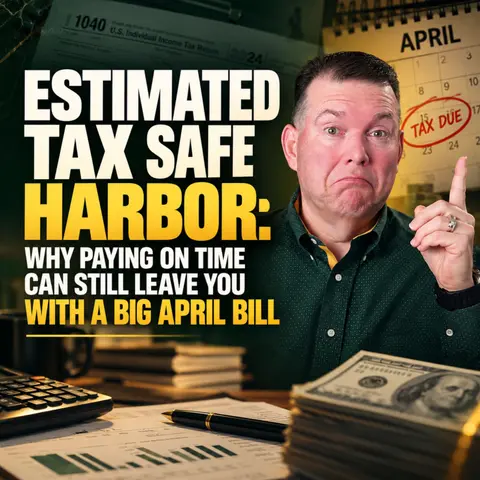
Estimated Tax Safe Harbor: Why Paying On Time Can Still Leave You With a Big April Bill
The owner who paid every estimate and still owed $15,000
Here is an owner who did everything right. He made all four estimated tax payments on time, and he still owed $15,000 in April, plus a penalty. The estimated tax safe harbor rule he followed was meant for someone earning less than he does, and nobody asked him the one question that would have caught it.
He runs a contracting business with about $1.6 million in revenue. It is a single-member LLC, and he files jointly with his wife. His profit last year was about $190,000. This year he is on track for about $260,000.
Is paying 100% of last year's tax always safe?
No. Once your adjusted gross income goes over $150,000, the safe harbor is 110% of last year's tax, not 100%. His tax last year was $41,700, so he paid about $10,400 a quarter. At 110% he needed to pay about $45,900. He came up $4,200 short, and the IRS charges interest and a penalty on that.
The penalty is the small problem. His tax this year is closer to $56,700, so even if he had paid the full 110%, he would still owe about $10,800 in April. Safe harbor protects you from the penalty. It does not protect you from the bill, so set aside the difference as you go.
What is your real profit margin?
Most owners count their own pay as profit, and that flatters the number. Say this owner could earn $120,000 working for someone else. Take that out of his $260,000 and his true profit is $140,000. On $1.6 million in sales, that is an 8.75% net margin.
The benchmark I use is at least 10% pre-tax after you pay yourself. That would be $160,000, so he is $20,000 a year short. Over three years, that is $60,000.
Should you buy equipment before December 31?
Only if you need it. At his income, a $10,000 machine saves about $2,000 in federal tax, so it really costs $8,000. A deduction is a discount on something you already had to buy. It is not free money.
The step to take this week
Pull last year's return and find two numbers: your total tax and your AGI. If your AGI was over $150,000, your safe number is 110%. Then send your accountant five questions. Have I paid enough to be safe? What is my real margin? Am I paying myself the right way for my entity? What am I buying before December 31? What do I want this business to pay me in three years?
If your accountant cannot answer them, you have a preparer, not an advisor.
I also do a one-on-one year-end review for $199.
Book your year-end reviewcontentcreatorsaccountant.com/review
President
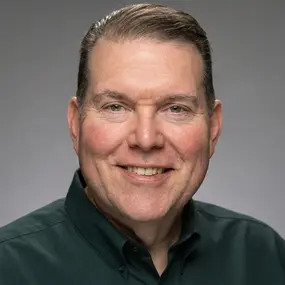
Ralph V. Estep, Jr. is a Delaware-based licensed accountant, author, rancher, and media host with more than 30 years of experience in finance, taxation, and small-business leadership. As the founder of Saggio Accounting+PLUS and the creator of the Ask Ralph Media network, Ralph helps entrepreneurs, creators, and everyday families replace money confusion with clarity, confidence, and practical next steps—without shame and without hype.
Ralph’s work blends deep professional expertise with a coach’s mindset and a communicator’s heart. He has held leadership roles across public accounting, financial institutions, law firms, and technology organizations, bringing a rare combination of traditional accounting rigor and modern systems thinking to the people he serves. A graduate of the University of Delaware and Wilmington University (MBA), Ralph is known for turning complex money topics into simple, repeatable frameworks that help people make wiser decisions and build lasting financial stability.
Through Ask Ralph Media, Ralph hosts multiple shows designed to meet people where they are and guide them forward. He is the host of Financially Confident Christian, a daily, faith-based show offering warm, pastoral encouragement for listeners who want peace and practical wisdom with their finances.
He also hosts Truth Unveiled with Ralph, a weekly program that contrasts cultural pressure with biblical truth and invites listeners into deeper spiritual and practical alignment. For small business owners, Ralph leads Grit and Growth Business, spotlighting real sto… Read More
The SBA Just Recognized Creators as Real Businesses. Here's What That Means for Your Money.