The SBA Just Recognized Creators as Real Businesses. Here's What That Means for Your Money.
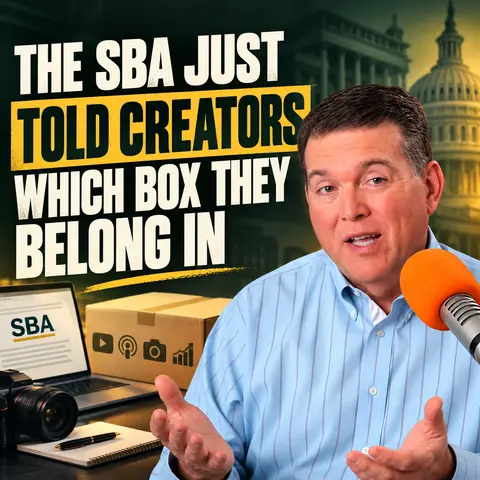
The SBA Just Recognized Creators as Real Businesses. Here's What That Means for Your Money.
For years, if you made your living creating content (podcasting, streaming, making videos), you lived in a paperwork no-man's-land. Your bank called you "media." Your tax software called you "other services." And when you walked into a lender's office, nobody was quite sure what box you belonged in.
On October 15, that changed.
The U.S. Small Business Administration issued its first-ever guidance specifically recognizing content creators in the federal small-business framework. The SBA says the nation's 27 million creator-led businesses should be classified under NAICS 5121, Motion Picture and Video Industries, for SBA program eligibility. As Administrator Kelly Loeffler put it, creators "are entrepreneurs who build businesses from original ideas, unique audiences, and content into thriving small businesses that create jobs."
That's not a participation trophy. Classification is plumbing, and plumbing determines whether money can flow to you.
Why a NAICS code matters more than you think
Your NAICS code is the federal government's answer to "what does this business actually do?" It shows up on your tax return, your loan applications, your business bank account, and your insurance policies. SBA size standards, the lines that decide whether you count as a "small business" eligible for SBA-backed loans and contracting programs, are set by NAICS code.
Until now, creators had no clear guidance on which code fits a business that writes, shoots, edits, distributes, markets, and monetizes its own content across five platforms and four revenue streams. The SBA's announcement says it plainly: creators were technically eligible for SBA support all along, but they "previously lacked clear guidance on the NAICS code that best reflects their integrated business models." The guidance names the umbrella: podcasters, streamers, gamers, filmmakers, video producers, digital publishers, social-media entrepreneurs, and creative agencies all start at 5121 and select the six-digit code that best matches their primary activity.
Daniel Abas, founder of the Creators Guild of America, called it the federal government "unequivocally" affirming that content creators are small businesses. He's right, and the timing matters.
What this does, and doesn't, do
Let's be precise, because this is where creators get hurt: by hype.
It does: give you and your lender a shared, official classification to start from, so an SBA loan conversation doesn't die at "so… what exactly is your business?" It aligns how the SBA sees creator businesses across lending and contracting programs. And the comment period on the underlying size-standards rule is open until November 20. Creators have formally asked for a permanent industry exception, and the SBA will consider it after comments close.
It doesn't: guarantee anyone a loan. You still need revenue, creditworthiness, financial statements, and a business that a lender can underwrite. A classification is a door being unlocked, not a check being written.
What to do with this, this quarter
1. Check your classification. Look at the NAICS/principal business code on your most recent business tax return and your formation documents. If it says something vague or wrong ("consulting," "other," a code from a business you no longer run), flag it for correction with your accountant at year-end. Mismatched codes across your return, bank, and loan paperwork are a small thing that creates big friction.
2. Get your books lender-ready before you need a lender. SBA-backed financing runs on documentation: clean, separated business financials, tax returns that match your books, and revenue you can prove by stream. If your sponsorship money, ad revenue, memberships, and affiliate income all land in one personal account, fix that now, not the week you apply.
3. Talk to your local SBDC or SBA district office. Free, and now they have official guidance to work from when a podcaster walks in.
4. Weigh in before November 20. If you want creator businesses permanently housed in the classification system rather than borrowed from the film industry, the comment period on the proposed rule is where that gets decided.
The bigger point
I've spent 30 years telling creators and small business owners the same thing: the government, the banks, and the tax code reward businesses that look like businesses on paper. This guidance is Washington catching up to what was already true: a podcast with sponsors, contractors, and six figures of revenue is a small business, full stop.
Now the paperwork agrees. Make yours agree too.
If you want help getting your creator business's books, entity, and year-end tax position lender-ready before December 31, that's exactly what my Year-End Business Review is for: one hour, your numbers, a plan.
Ralph Estep Jr., LPA
Host of The Content Creator's Accountant; founder, Saggio Accounting+PLUS
Source: U.S. Small Business Administration, "SBA Issues Historic Guidance to Recognize America's Content Creator Economy," October 15, 2026.

President
Ralph V. Estep, Jr. is a Delaware-based licensed accountant, author, rancher, and media host with more than 30 years of experience in finance, taxation, and small-business leadership. As the founder of Saggio Accounting+PLUS and the creator of the Ask Ralph Media network, Ralph helps entrepreneurs, creators, and everyday families replace money confusion with clarity, confidence, and practical next steps—without shame and without hype.
Ralph’s work blends deep professional expertise with a coach’s mindset and a communicator’s heart. He has held leadership roles across public accounting, financial institutions, law firms, and technology organizations, bringing a rare combination of traditional accounting rigor and modern systems thinking to the people he serves. A graduate of the University of Delaware and Wilmington University (MBA), Ralph is known for turning complex money topics into simple, repeatable frameworks that help people make wiser decisions and build lasting financial stability.
Through Ask Ralph Media, Ralph hosts multiple shows designed to meet people where they are and guide them forward. He is the host of Financially Confident Christian, a daily, faith-based show offering warm, pastoral encouragement for listeners who want peace and practical wisdom with their finances.
He also hosts Truth Unveiled with Ralph, a weekly program that contrasts cultural pressure with biblical truth and invites listeners into deeper spiritual and practical alignment. For small business owners, Ralph leads Grit and Growth Business, spotlighting real sto… Read More
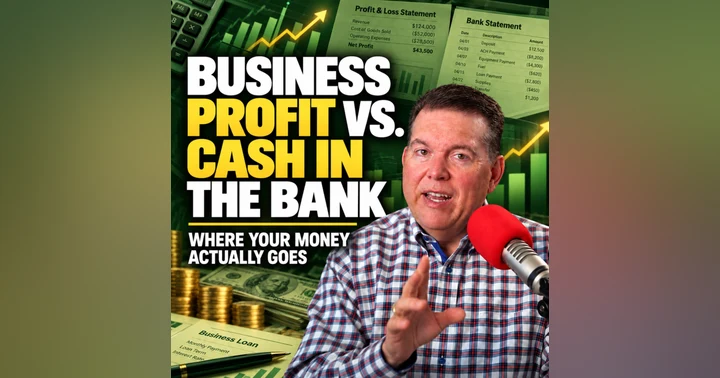
Business Profit vs. Cash Flow: Why You're Profitable but Have No Money in the Bank