
The Real Reason Your Podcast Isn't Making You Money

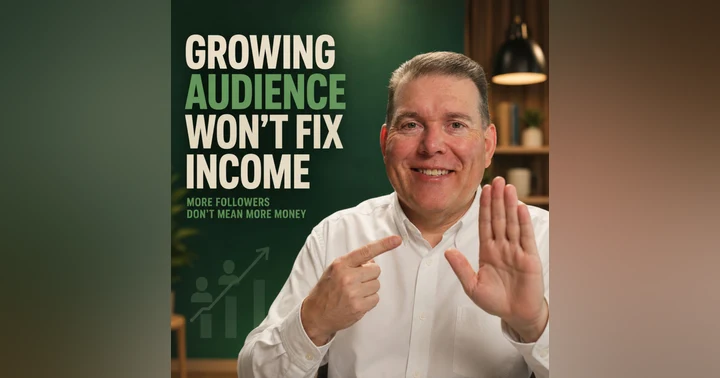
I've spent 30 years as a licensed public accountant, and I've sat across the desk from thousands of small business owners going over their real numbers, not the ones they post online. Here's what I've learned about podcast business finances: almost nobody is waiting on a good year. They're waiting on a system.
I recently spoke at Empowered Podcasting 3 in Charlotte, and I asked the room a simple question. How many people want to make money with their podcast? Every hand went up. Then I asked how many were actually making money right now. Silence. That gap between wanting income and having it is where most creators live, and it's not usually a content problem.
The hourly rate nobody calculates
I have a client, Tom, who owns a towing business. I asked him what he thought he could earn working an hour at McDonald's. He said fifteen dollars, Delaware's minimum wage. Then I pulled his tax return. He was making four dollars an hour in his own business.
Podcasters need to run that same math. Add up the hours you spend on planning, recording, editing, show notes, thumbnails, and social promotion. Multiply by how often you publish. Then multiply by what you think your time is worth. If you spend 25 hours a month and value your time at 25 dollars an hour, that's 625 dollars a month, or 7,500 dollars a year, in labor you never invoice yourself for.
You're not going to stop doing your show over that number. But seeing it changes how you think about every dollar that comes in after.
Do I need to make money to justify my podcast?
No, but you do need to know what it's costing you. A lot of people start a podcast because they want a side hustle, want out of their nine to five, or have a dream they're chasing. None of those reasons are actually about audio. They're about money and freedom. Once you name that honestly, it gets a lot easier to build a system instead of hoping the algorithm saves you.
Give every dollar a job
I hate the word budgeting. It sounds like restriction. Instead, assign every dollar a purpose the moment it arrives. If you bring in 3,000 dollars, decide right away what goes to rent, groceries, debt, savings, and fun, until you hit zero. The dollars that get you in trouble are the ones without an assignment, the forgotten subscriptions, the auto-renewals nobody remembers signing up for.
Track everything for 30 days
Most people think they know where their money goes. They're usually wrong, often by a wide margin. For 30 days, write down every dollar in and every dollar out. No app needed, just a notebook. You'll find convenience spending, delivery fees, and subscriptions you forgot existed. It's death by a thousand small cuts, and thirty days of honest tracking will teach you more than thirty episodes will.
The gross is never yours
Land a 1,200 dollar sponsor and it feels like a win. But self-employment tax adds 15.2 percent on top of federal and state tax, so a chunk of that money was never yours to begin with. Set aside 30 percent of everything you earn the day it arrives, in a separate account. That habit alone prevents the panic that shows up every April.
Build a small buffer
You don't need three to six months of expenses to start. A thousand dollars covers a flat tire, or in my case, a well pump that failed on my farm at four in the morning for 4,000 dollars. A buffer gives you the freedom to turn down a sponsor that doesn't fit your audience instead of taking the first offer out of desperation.
Kill one debt at a time
Pick your smallest balance and throw every extra dollar at it while paying minimums on the rest. It's not the mathematically optimal move, interest rate math says otherwise, but finishing something builds the momentum that keeps you going.
This week, pick one of these five tools and start it today. If you don't know where to begin, start with tracking. Thirty days of clarity on where your money actually goes will change how you run your business.

President
Ralph V. Estep, Jr. is a Delaware-based licensed accountant, author, rancher, and media host with more than 30 years of experience in finance, taxation, and small-business leadership. As the founder of Saggio Accounting+PLUS and the creator of the Ask Ralph Media network, Ralph helps entrepreneurs, creators, and everyday families replace money confusion with clarity, confidence, and practical next steps—without shame and without hype.
Ralph’s work blends deep professional expertise with a coach’s mindset and a communicator’s heart. He has held leadership roles across public accounting, financial institutions, law firms, and technology organizations, bringing a rare combination of traditional accounting rigor and modern systems thinking to the people he serves. A graduate of the University of Delaware and Wilmington University (MBA), Ralph is known for turning complex money topics into simple, repeatable frameworks that help people make wiser decisions and build lasting financial stability.
Through Ask Ralph Media, Ralph hosts multiple shows designed to meet people where they are and guide them forward. He is the host of Financially Confident Christian, a daily, faith-based show offering warm, pastoral encouragement for listeners who want peace and practical wisdom with their finances.
He also hosts Truth Unveiled with Ralph, a weekly program that contrasts cultural pressure with biblical truth and invites listeners into deeper spiritual and practical alignment. For small business owners, Ralph leads Grit and Growth Business, spotlighting real sto… Read More
Your Downloads Are Up. Your Revenue Isn't. Here's Why.